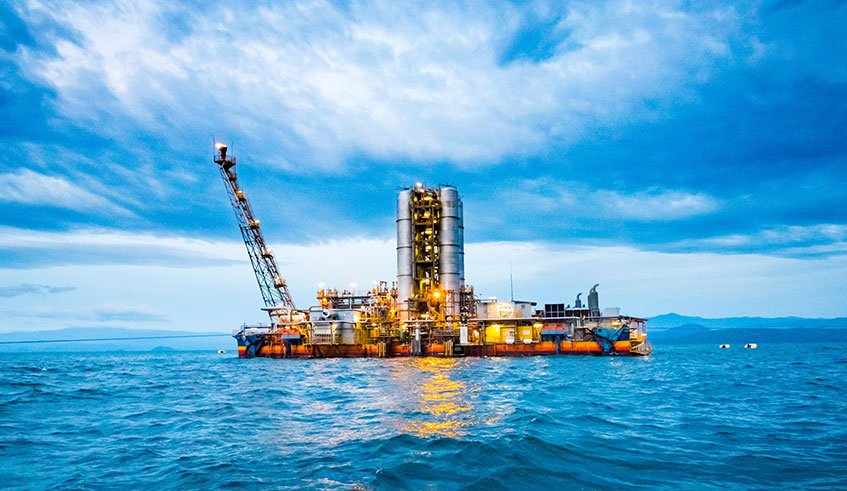
Rwanda’s government says households could start cooking with homegrown methane gas from Lake Kivu by early 2028, as rising LPG prices push the country to accelerate one of its most ambitious energy projects.
Rwanda’s Minister of State for Infrastructure, Jean de Dieu Uwihanganye, confirmed on April 5 that the first quarter of 2028 is now the target date for Rwandans to begin using compressed natural gas (CNG) extracted from Lake Kivu for cooking.
The announcement comes as the price of a 12kg LPG cylinder has climbed from Rwf21,000 to roughly Rwf30,000, a 43% jump that is squeezing households across the country.
The timing is not accidental
Uwihanganye pointed directly to the ripple effects of the conflict involving Iran, Israel, and the United States, saying “even when this war ends, there will still be aftereffects and therefore long-term measures are needed.” Global oil market instability has exposed just how vulnerable Rwanda’s energy basket remains, and the Lake Kivu project is now being framed as a strategic response, not just an infrastructure milestone.
Construction of the CNG plant began in August 2022, when the then Prime Minister Edouard Ngirente broke ground at a facility in Karongi District, Western Province.
The $400 million concession agreement between the government and Gasmeth Energy was originally signed in February 2019 but was delayed by several factors, including the COVID-19 pandemic.
Lake Kivu holds an estimated 60 to 70 cubic kilometers of methane, of which 44.7 cubic kilometers are considered extractable. Gasmeth’s plant is designed to produce 40 million standard cubic feet of gas per day roughly 990,000 cubic meters with 35 to 40 percent earmarked specifically for cooking gas.
The social dimension is just as significant. According to Rwanda’s most recent household survey, 75% of households still cook with firewood and 18.8% use charcoal meaning only about 5.4% currently use gas or biogas. Schools alone account for 45% of all firewood consumed in the country. If the Lake Kivu plant delivers on schedule, it could fundamentally shift that picture and spare millions of trees annually.
To stabilize supply in the meantime, the government and private sector have begun building storage facilities in Rusororo Sector, Gasabo District, designed to hold up to 15,000 cubic meters of gas as a buffer against import disruptions.
What happens next depends on execution
The 2028 deadline is the third major target Rwanda has set for this project earlier timelines in 2022 and 2025 came and went. But the political pressure has never been higher. gas prices are at record levels, the global energy market is unstable, and Rwanda’s clean cooking ambitions including a plan to eliminate firewood from schools by 2032 require this project to deliver.
A total investment of $1.37 billion is estimated to be needed by 2030 to cut charcoal use to 42% making the Lake Kivu gas project not just a convenience upgrade, but a cornerstone of Rwanda’s entire energy transition strategy.
If Gasmeth hits its targets, Rwanda would become one of the few countries in Africa producing its own cooking gas at industrial scale from a lake that has powered its electricity grid for years.
About the Author