April 7, 2026 | Kigali
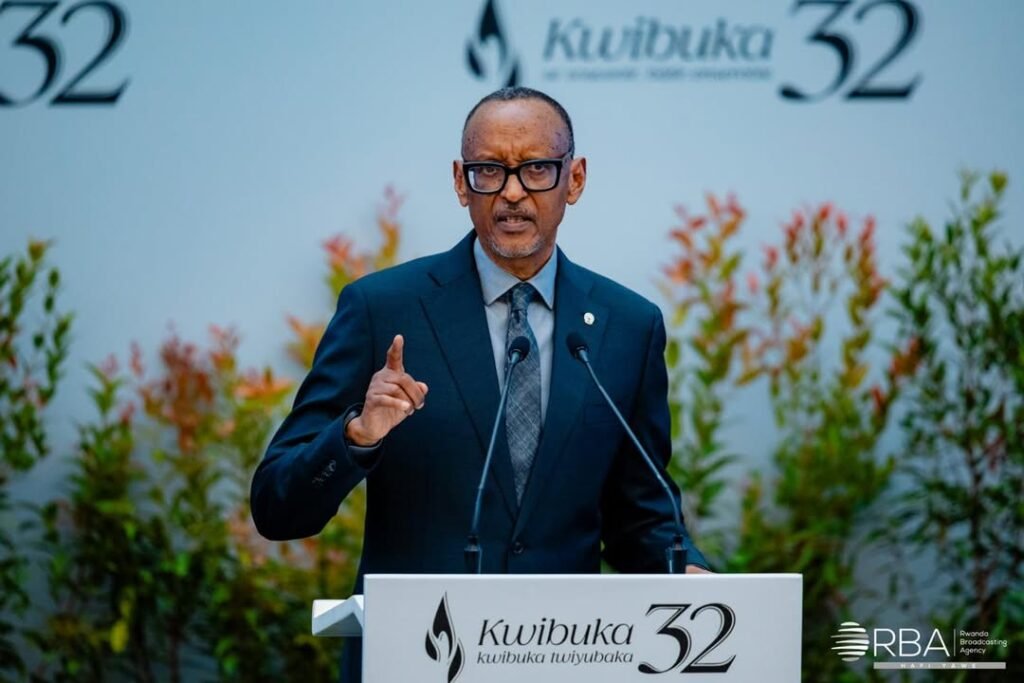
Rwanda’s President Paul Kagame laid out on Tuesday a systematic account of how the international community was warned about the 1994 genocide against the Tutsi; had the means to prevent or reduce its scale; and chose not to act, drawing a direct line between that failure and the dangers the region faces today.
Speaking at the Kwibuka 32 national ceremony, President Kagame named specific actors, specific warnings, and specific decisions. The result was one of the most detailed public indictments of international inaction he has delivered at a Kwibuka ceremony. He cited the January 1994 intelligence fax sent by the commander of the United Nations mission in Rwanda to UN headquarters in New York, a document containing detailed intelligence that the Interahamwe were stockpiling weapons and had compiled lists of Tutsis to be killed. The commander was ordered to share the information with the very government preparing the genocide and to take no further action. Three months later, the killings began.
President Kagame also pointed to the decision to withdraw peacekeepers when the genocide started. At the ETK Kicukiro site, when peacekeepers pulled out, thousands of Tutsis who had gathered there for protection were left to die. He said the peacekeepers who were allowed to remain saved lives, making clear how many more could have been saved with political will.
He addressed the technology question directly: the broadcasts on Radio Mille Collines were directing killers to their targets in real time. The planes capable of jamming those signals existed. Officials calculated the hourly cost of running such a mission. The conclusion was that it was too expensive. “Our lives were worth nothing,” President Kagame said. “That’s fine.”
He also recalled the deliberate linguistic evasion: governments that refused to use the word “genocide” even as the killings accelerated, knowing that the term carries a legal obligation to act under international law. “To witness such a crime and deliberately refuse to use the term is, in effect, genocide denial,” he said, “perhaps even a form of aiding and abetting.”
President Kagame went further back in history, citing the early 1960s when international figures, including Bertrand Russell, described what was happening in Rwanda as systematic extermination, and the world did not respond. He named the 1993 commission led by Jean Karabinar, which documented mass graves and state involvement and concluded explicitly that a genocide was being prepared. He cited the 1993 warning from UN Special Rapporteur Bacri Welly Ndiaye that organized anti-Tutsi propaganda was spreading openly.
“The reaction today is no different,” President Kagame said, referring to what he described as continued passivity in the face of ongoing threats in the region. The account is significant beyond its historical value. At a moment when Rwanda faces international pressure over its security posture in eastern DRC, President Kagame’s detailed recounting of 1994 serves as a framework for how Kigali reads the current situation: a world with a demonstrated pattern of watching, calculating, and choosing inaction until the cost becomes impossible to ignore.
About the Author