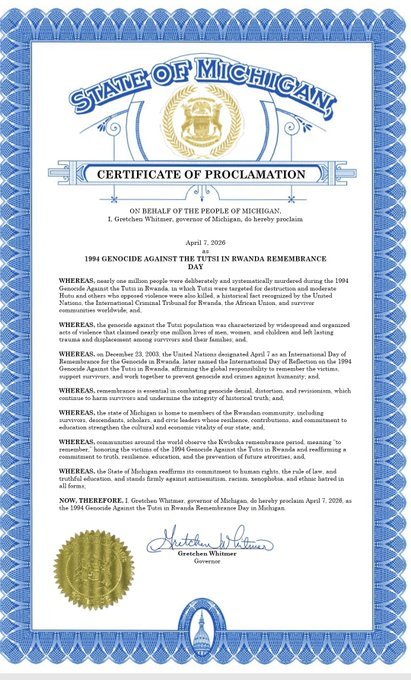
Michigan Governor Gretchen Whitmer signed an official state proclamation on April 7, 2026, declaring the day as “1994 Genocide Against the Tutsi in Rwanda Remembrance Day” across the entire state of Michigan making it one of the strongest pieces of formal recognition to come out of the United States during Kwibuka 32.
The proclamation did not come alone. The City of Kentwood, Michigan, issued its own separate declaration the same day, with Mayor Stephen C.N. Kepley urging residents to “learn from the past so that these types of atrocities may never take place in the world again.”
Governor Whitmer’s proclamation acknowledged that Michigan is home to members of the Rwandan community, including survivors, descendants, scholars, and civic leaders “whose resilience, contributions, and commitment to education strengthen the cultural and economic vitality of our state.”
It went further, grounding the recognition in hard historical fact: nearly one million people were deliberately and systematically murdered during the 1994 Genocide Against the Tutsi in Rwanda a historical fact recognized by the United Nations, the International Criminal Tribunal for Rwanda, the African Union, and survivor communities worldwide.
The state also used the proclamation to take a clear position against denial reaffirming Michigan’s commitment to “human rights, the rule of law, and truthful education,” and standing firmly against racism, xenophobia, and ethnic hatred in all forms.
Ibuka USA: This Is More Than Symbolic
The proclamations came as a direct result of sustained advocacy by Ibuka USA, the survivors’ association that has been organising Kwibuka events across America for years.
Marcel Mutsindashyaka, President of Ibuka USA, welcomed the Kentwood proclamation directly. “This proclamation is deeply significant,” he said, adding that such recognition plays a critical role in preserving memory and advancing efforts to prevent future atrocities.
Mutsindashyaka was also among the survivors who spoke at the UN Headquarters ceremony in New York on April 7. He lost 25 members of his family in the genocide and now leads Ibuka USA, a group that advocates for genocide survivors and organises remembrance events across the US to honour victims and educate current and future generations.
Michigan’s twin proclamations state and city level are part of a coordinated pattern unfolding across North America during Kwibuka 32. In Canada, Toronto Mayor Olivia Chow issued her own proclamation the same day at City Hall, personally handing it to the Rwandan community gathered before her.
From state governors to city mayors, the message during this Kwibuka season has been consistent. The United States also reaffirmed its strong stance against genocide denial and historical distortion, with a senior State Department official stating: “We oppose any attempt to misrepresent the historical record and reject any denial or minimization of the genocide.”
Why This Matters for Rwanda
Thirty-two years on, the fight for accurate historical recognition is still active. Genocide denial and distortion persist online and in some political circles internationally. Each state-level proclamation especially one signed by a sitting U.S. governor creates a formal public record that is harder to erase than a social media post or a community event.
Survivor Marcel Gasore, speaking at the UN commemoration in New York, put it plainly: “Hate speech is spreading faster than ever. In 1994, hate was broadcast through RTLM radio.” Today, the platforms have changed, The danger has not.
Michigan’s proclamation is a reminder that the diaspora’s diplomatic work quiet, persistent, and year-round is paying off. The 100-day Kwibuka period runs through mid-July, and more recognitions are expected across American cities as Ibuka USA continues its outreach.
About the Author