Pope Leo XIV landed in Algeria on Monday, becoming the first pontiff in history to visit the Muslim-majority nation and launching an ambitious 11-day tour across four African countries that signals a clear shift in where global Catholicism is headed.
After two days in Algeria, Leo will continue to Cameroon, Angola, and Equatorial Guinea in a tour covering nearly 18,000 kilometres across 18 flights.
The trip is being watched closely not just for its religious weight, but for its political timing — and Africa’s growing place at the center of it all.
Pope Leo XIV arrived in Algiers on Monday, calling for peace in all nations, with the trip overshadowed by the U.S.-Israeli war in Iran and an extraordinary public attack on Leo by U.S. President Donald Trump.
Trump had accused the Pope of “catering to the Radical Left,” a reference to Leo’s open condemnation of the Iran war. Leo, for his part, did not flinch.
On the plane to Algeria, he told journalists that the Vatican’s appeals for peace and reconciliation are rooted in the Gospel, and that he did not fear the Trump administration.
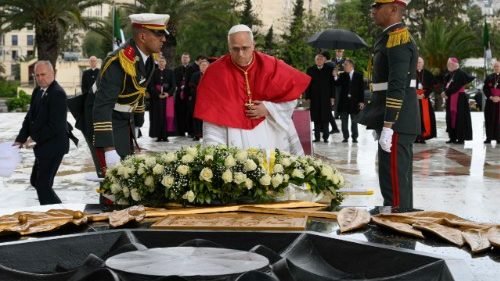
In Algiers, Leo’s first act was symbolic and deliberate. He visited a monument to the martyrs of Algeria’s violent struggle for independence from France, during which hundreds of thousands died.
A pope planting flowers at an anti-colonial war memorial, in a Muslim-majority country, while under attack from the American president that is not a coincidence. It is a posture.
Pope Leo’s decision to make Africa one of the early stops of his papacy signals the continent’s centrality in global Catholicism.
His April 2026 visit reflects both personal ties to Africa and the rapid rise of Christianity across the continent.
The numbers explain the urgency. Africa today has 288 million Catholics, 20.3 percent of the world’s total Catholic population, and it is the fastest-growing region for the faith anywhere on earth.
Africa contributed more than half of the 15.8 million new Catholics baptised in 2023 some 8.3 million new African Catholics in a single year.
For a church whose membership is declining in Europe and North America, Africa is not a mission field. Africa is the future.
What This Means for Rwanda and the Region
Rwanda is not on Leo’s current itinerary, but the implications of this visit extend well beyond the four countries he is physically visiting.
Rwanda’s Catholic Church, historically one of the most influential institutions in the country’s social fabric, is part of the same continental story Leo is addressing, a church grappling with painful history, seeking reconciliation, and navigating the state.
Catholic priests and sisters across Africa expect the visit to ignite hope and offer comfort to a region suffering armed conflict, drought, and a deepening humanitarian crisis worsened by the withdrawal of U.S. development aid this year.
Rwanda, which has seen U.S. aid cuts affect several social programmes, sits squarely within that reality.
Leo is expected to speak about corruption in often authoritarian regimes and the role of political leaders a theme that will resonate far beyond Cameroon and Equatorial Guinea, the specific targets of that message.
Leo is expected to deliver 25 speeches over 11 days, covering Christian-Muslim coexistence, exploitation of natural resources, corruption, and migration.
The biggest moment comes Friday in Douala, Cameroon, where 600,000 faithful are expected at a single outdoor Mass.
The broader diplomatic signal is already being read clearly. Leo’s decision to visit Algeria and tackle interfaith relations is being interpreted as his emergence as a diplomatic counterweight to the Trump administration and its military intervention in Iran.
For Africa, having a pope who is young, healthy, politically vocal, and personally connected to the continent is a different kind of relationship with Rome.
The Catholic Church in Africa can seize this moment to build more equal partnerships with churches in the global north where membership is declining.
About the Author