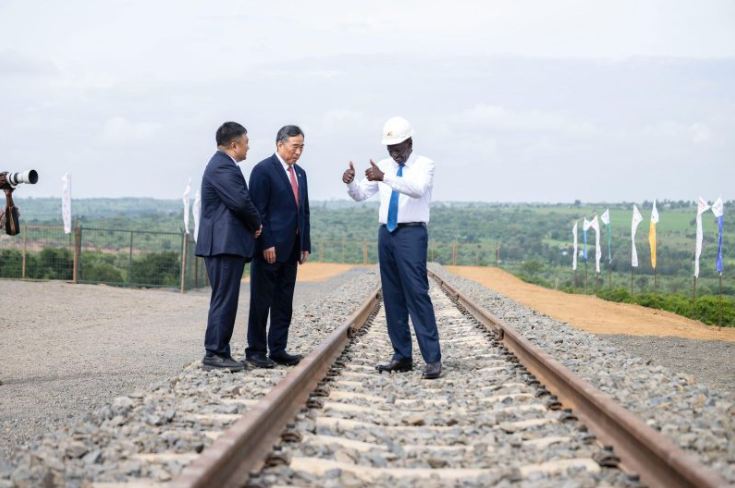
President William Ruto on Thursday March 19, launched construction of a 370-kilometre Standard Gauge Railway (SGR) extension from Naivasha to Malaba, positioning the project as the next phase in Kenya’s long-term strategy to transform regional transport and trade.
Speaking at the groundbreaking in Narok County, Ruto framed the project as a continuation of a decade-long infrastructure shift away from colonial-era systems.
“In 2014, we embarked on the bold task of replacing the 130-year old colonial railway line from Mombasa to Kisumu, infamously called the ‘Lunatic Express’, with a modern Standard Gauge Railway,” he said.
“The first phase of the SGR, running from Mombasa to Naivasha, was initially dismissed by skeptics as a ‘railway to nowhere’. But today, it stands vindicated as a transformative backbone of our national transport system, driving efficiency in the movement of goods and passengers.”
Ruto said Kenya is now advancing the next stage of the project to deepen regional connectivity.
“We are now advancing the next phase by extending the SGR from Naivasha to Kisumu and eventually to Malaba,” he said.
“The Naivasha–Kisumu main line will span 264 kilometres, complemented by an 8.69 kilometre line branching to the proposed new Kisumu Port, while the Kisumu–Malaba section will cover 107 kilometres, seamlessly linking Kenya to Uganda and the wider region.”
He added that the railway will traverse nine counties—Narok, Bomet, Nyamira, Kericho, Kisumu, Siaya, Vihiga, Kakamega and Busia—unlocking economic potential across western Kenya.
“This strategic corridor will significantly ease the movement of people, goods and services. It will also catalyse regional economic growth and firmly position Kenya as a leading transport and logistics hub in Eastern and Central Africa,” Ruto said.
Kenya’s Cabinet Secretary for Roads and Transport, Davis Chirchir, said the extension is critical to unlocking trade along the Northern Corridor.
“It is really significant for us to extend this railway from Naivasha to Kisumu and subsequently to Malaba to open up the northern corridor and support the transportation of goods from the port of Mombasa, which serves inland countries such as Uganda, Rwanda and the Democratic Republic of Congo,” Chirchir said.
“For us, it is so significant… it opens up a gateway and facilitates competitive transportation of goods to the region,” he added.
According to Kenya Railways Corporation, the project—already underway with contractors mobilised in Narok and Kisumu—will deliver 370 kilometres of railway, including 35 stations across 11 counties, 108 major bridges, 14 tunnels spanning 21 kilometres, 556 culverts, and 95 road bridges.
The modern railway will significantly outperform the old metre-gauge system, increasing speeds from 25 km/h to 120 km/h and boosting cargo capacity from 1,000 tonnes to 4,000 tonnes per train.
Officials say the upgrade is critical to improving efficiency along the Northern Corridor, which handles over 30 million tonnes of cargo annually, most of it destined for landlocked economies including Uganda.
Currently, up to 90% of cargo along the corridor moves by road, contributing to high logistics costs and congestion. Rail transport is expected to cut freight costs by 30–40% and reduce transit times by up to 50%.
Analysts say Kenya’s rapid progress could reshape regional trade flows, increasing pressure on Uganda to fast-track its rail network to avoid bottlenecks at Malaba.
If completed in sync, the SGR extension could transform East Africa’s supply chains, linking the Port of Mombasa to inland markets with faster, cheaper and more reliable transport—cementing rail as the backbone of regional trade.
About the Author