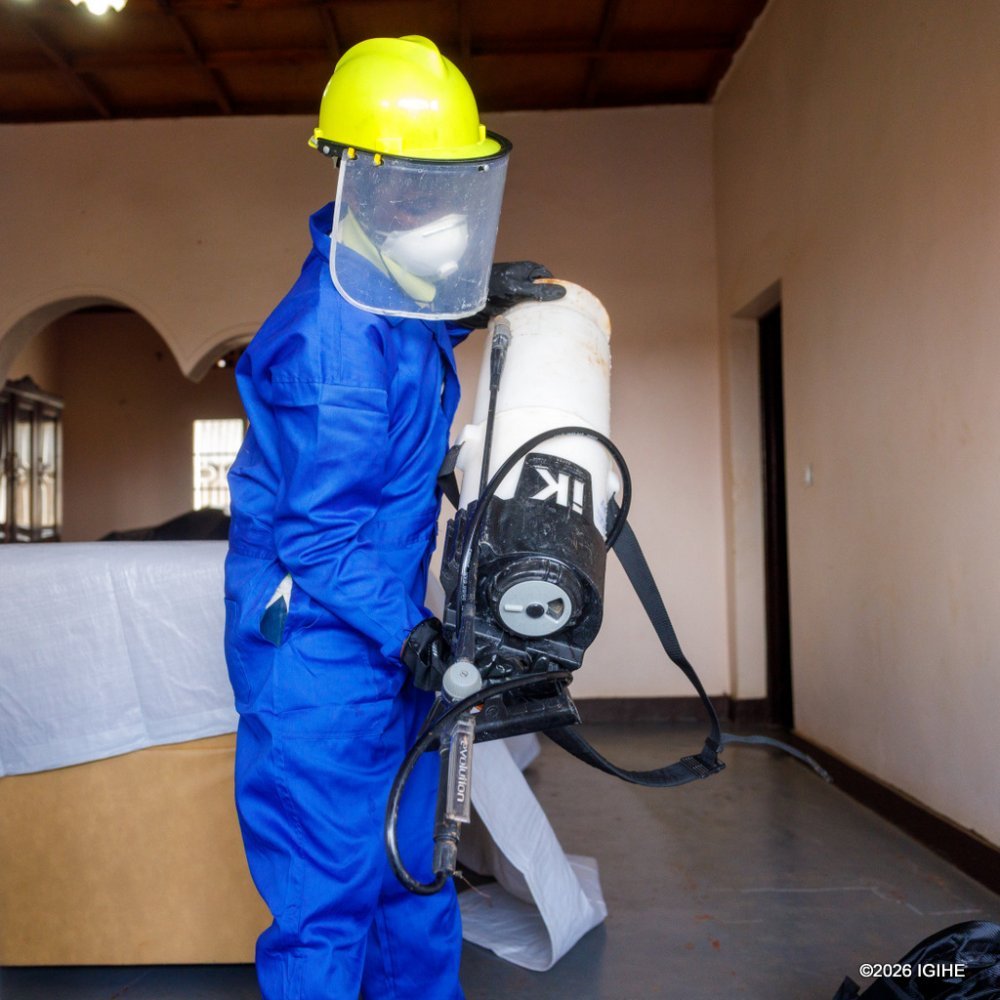
A non-governmental organisation supporting underprivileged communities, Strive Foundation, has launched a campaign to help residents in several sectors of Kigali City heavily affected by malaria. The initiative involves spraying insecticide in homes to kill mosquitoes and reduce transmission.
The program is being implemented in partnership with the Rwanda Biomedical Center (RBC), targeting more than 140,000 households across nine sectors in the Gasabo, Kicukiro, and Nyarugenge districts.
The affected sectors include Masaka in Kicukiro; Kanyinya and Mageragere in Nyarugenge; and Rutunga, Gikomero, Rusororo, Ndera, Jabana, and Kinyinya in Gasabo.
The campaign was launched in Masaka Sector, which has over 30,000 residents. Kicukiro District, where Masaka is located, has reported more than 115,000 malaria cases, making it the district with the highest number of infections.
Alfred Nduwayezu, Masaka Sector Executive Secretary, attributed the high malaria rates to local environmental factors, including marshlands used for rice cultivation and areas with stagnant water.
He explained: “When we track the data, the increase in malaria cases is linked to the local environment — there are marshes, rice fields, and water accumulation. RBC and its partners recognised the problem and approved indoor spraying in our sector to help address it.”
In Masaka, around 20,000 households are expected to receive the insecticide treatment.
Nduwayezu added that, in collaboration with partners, the sector has implemented measures to curb malaria and reduce infection rates, particularly during and after the rainy season when cases typically spike.
Léopold Ruzibiza, Programs Manager at Strive Foundation Rwanda, said previous interventions, including mass testing, clearing bushes, and other measures, had limited impact. Indoor spraying was therefore chosen as the most reliable method.
He emphasised the importance of residents following proper procedures during spraying:
“Residents must vacate their homes, remove all belongings from the rooms, and allow health workers to mix and apply the insecticide at the approved dosage. Houses are then sealed for two hours.”
Residents are being urged to cooperate fully, as the campaign is being carried out by trained health workers.
In October and December 2025, the campaign will expand to 28 sectors most affected by malaria in the Gisagara, Nyanza, Bugesera, Kirehe, Rwamagana, and Nyagatare districts, covering 1,031,676 residents.
According to the Rwanda Biomedical Center (RBC), malaria claimed over 150 lives nationwide between 2024 and 2025.
About the Author