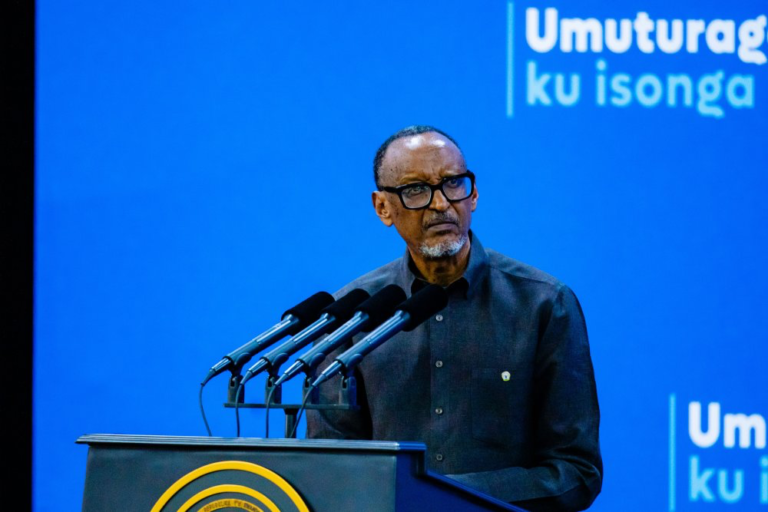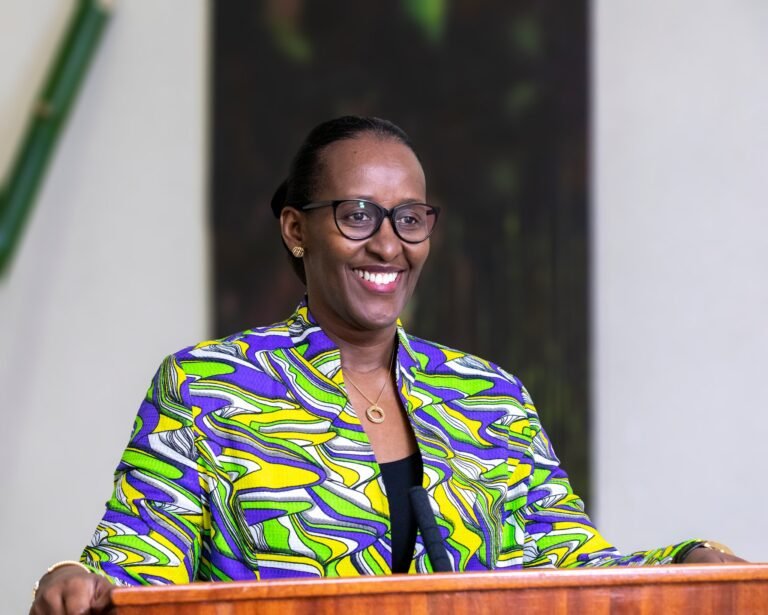
Rwanda’s First Lady Jeannette Kagame used Saturday’s RPF-Inkotanyi Women’s League General Assembly to name something most families recognise but rarely hear said out loud at the national level: a growing rift between parents and children that technology is making worse.
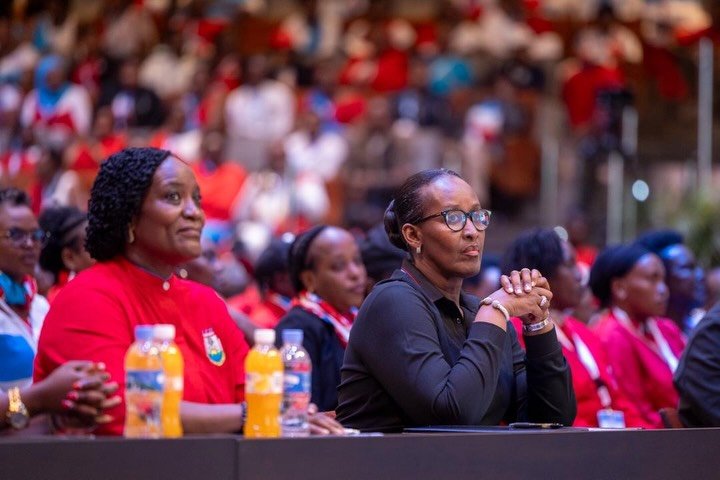
Speaking to more than 2,000 women at Intare Conference Arena in Rusororo, Mrs. Kagame described a pattern emerging in some Rwandan households where children see parents as adversaries who do not understand them, and parents see children as difficult or beyond discipline. She borrowed a French phrase to name it plainly: conflit de générations [a generational conflict].
“This should not be the case,” she said. “Modern progress should instead create opportunities to strengthen families. It is important that we learn how to live within it while choosing what aligns with our Rwandan values.”
ALSO READ: RWANDA: First Lady honours the women who held the country together before it was free
Her diagnosis pointed directly at the pace of technological change. Rwanda has moved fast deliberately and successfully, to build a digital economy. But Mrs. Kagame’s remarks suggest that speed has a social cost that is not yet fully visible in development statistics.
When children and parents inhabit different technological and cultural worlds, the family’s ability to transmit values breaks down. And when values are not transmitted at home, she warned, children are left without a filter when they encounter foreign influences.
“A child who was not taught values such as patriotism, respect, unity, cooperation, integrity, and self-worth when exposed to foreign influences without that foundation may adopt everything without knowing how to distinguish right from wrong,” she said.
ALSO READ: RWANDA: First Lady tells 2,000 women that loving the country must be a daily act
The warning carries particular weight in Rwanda’s context. The country’s development model has always treated the family as the basic unit of national progress. Rwanda’s Vision 2050 and the current National Strategy for Transformation 2024–2029 both rest on the assumption that strong households produce strong communities, which produce a strong economy.
If that foundation is quietly weakening, the implications go well beyond any single household. Mrs. Kagame was careful not to place the burden entirely on women. Parenting, she said, is a shared responsibility between mothers and fathers.
But in a room of 2,000 women who together reach every district in the country, her message had a clear operational edge: the Women’s League is one of the few networks capable of carrying this conversation from the national stage into the home. The assembly’s resolutions are expected to be released in the coming days.
About the Author