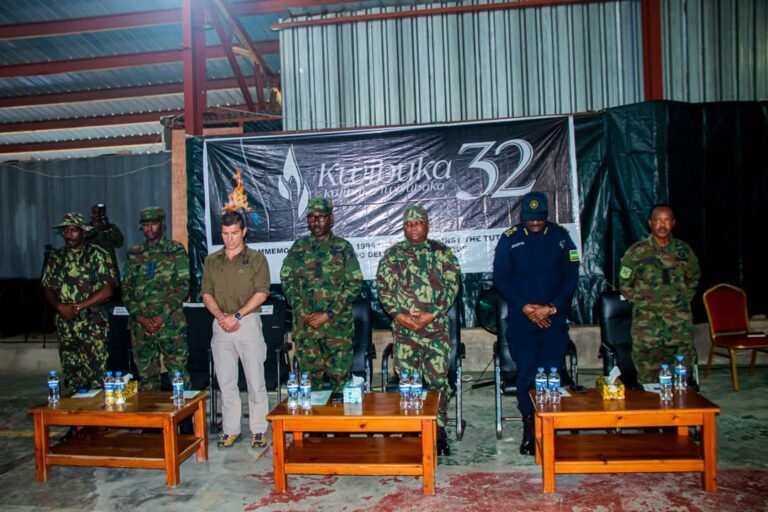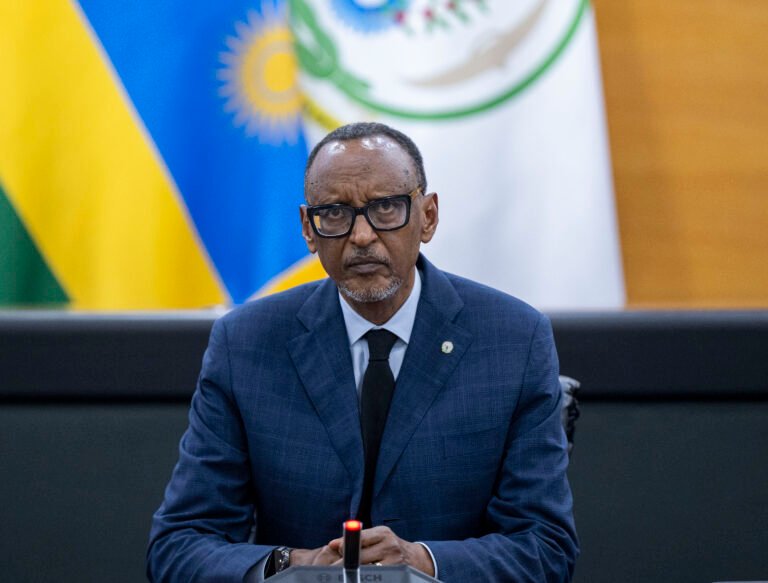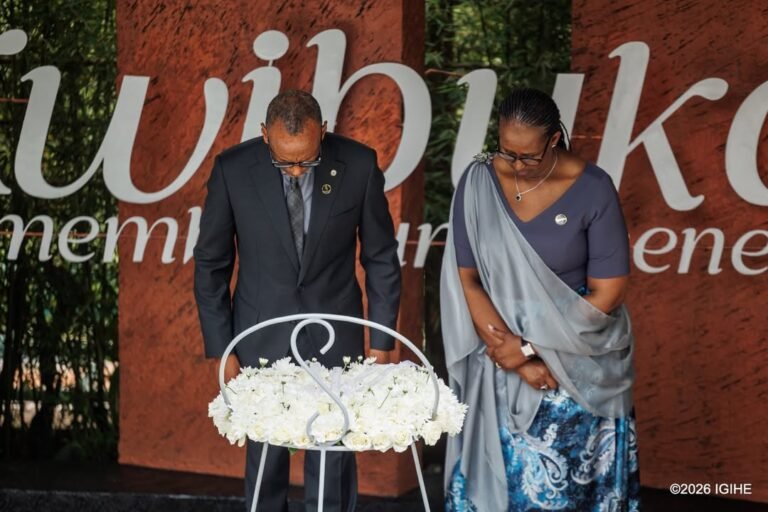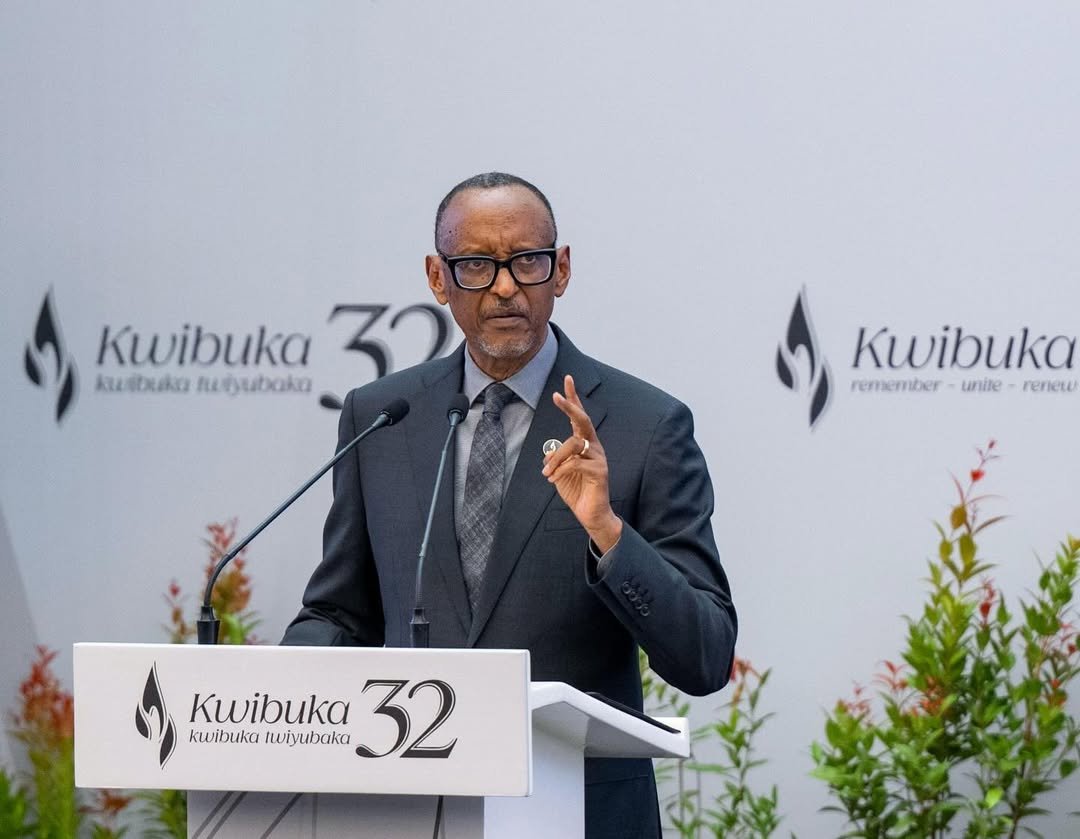
President Kagame opened Kwibuka 32 in Kigali with a clear message.[Courtesy]
April 7, 2026 | Kigali
Rwanda’s President Paul Kagame opened the 32nd commemoration of the genocide against the Tutsi on Tuesday with a direct warning to forces he said are still gathering against the country, declaring that no threat, external or internal, will reverse Rwanda’s path.
Speaking at the national ceremony in Kigali on April 7, 2026, President Kagame addressed survivors, foreign dignitaries, and millions watching online and on national television. This year’s commemoration is held under the theme “Remember, Unite, Renew,” a call to honor the dead, stand with survivors, and recommit to a future built on peace.
“Genocide cannot happen here again. It won’t happen,” President Kagame said, speaking directly to those he described as gathering in regional capitals and European cities with the intention of destabilizing Rwanda. He acknowledged the noise but dismissed it categorically, not as a personal position, but as the shared conviction of every Rwandan, young and old.
The commemoration marks 32 years since a genocide that claimed more than one million Tutsi lives in just 100 days. At the Kigali Genocide Memorial, where the national ceremony is anchored, more than 250,000 victims are buried. President Kagame paid tribute to a survivor who testified at the ceremony, saying their accounts keep memory alive not just for Rwanda but for the world.
The speech was wide-ranging. President Kagame revisited the documented preparations that preceded the genocide, the training of militias, the mass importation of weapons, the smaller massacres designed to normalize killing and test international reaction. He cited the 1993 UN Special Rapporteur’s warning that organized propaganda was openly preparing the population for mass violence and the January 1994 intelligence fax sent by the UN mission commander in Kigali to headquarters in New York, a fax that was suppressed and its author ordered to take no further action.
On the international community’s failure, President Kagame was blunt. He said the technology to jam the radio broadcasts directing the killings existed, that planes capable of doing so were available, and that officials had even calculated the cost only to decide the lives at stake were not worth it. “Our lives were worth nothing,” he said. “That’s fine.”
The commemoration is internationally recognized, with endorsement from bodies including the United Nations and the African Union. The African Union Commission organized a parallel Kwibuka 32 ceremony at its headquarters in Addis Ababa on the same day, reflecting the growing global footprint of the commemoration.
President Kagame used the occasion to directly address what he called the ongoing spread of genocide ideology in Rwanda’s region, naming the FDLR, the armed group descended from the 1994 genocidal forces, as a continued and unresolved threat. He called on African institutions to act decisively when Africans are at risk, warning that the continent accounts for the majority of the world’s active conflicts today and that moral passivity in the face of violent extremism has a well-documented price.
The 100-day mourning period now begins. Rwanda’s national flag will fly at half-mast throughout the week of mourning, and commemoration activities will be held in all 30 of the country’s districts.
About the Author