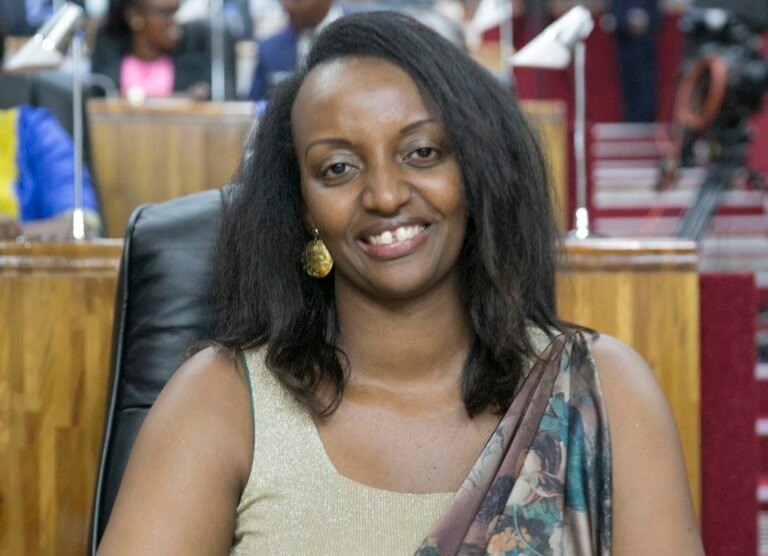
NBR Governor Soraya Hakuziyaremye's full assessment of Rwanda's economic position in one of the most candid central bank interviews in recent years.
Rwanda is navigating a compressed set of external pressures: US Treasury sanctions on the Rwandan Army and some of its high-ranking officers, a franc trading above 1,460 to the dollar, headline inflation above the central bank’s ceiling, and an active conflict in the DRC. Speaking on the Long Form Podcast in what is one of the most substantive public assessments by a Rwandan monetary official in recent memory, National Bank of Rwanda Governor Soraya Hakuziyaremye surveyed all of it and offered a single-word summary: resilience.
“The US dollar is at 1,460 against the franc. The US Treasury has sanctioned the RDS. There is a war in the Middle East. There is a war in the DRC. There are issues in Mozambique. While all these things are happening, the Rwandan population is hopeful. It’s growing. And it expects more.” She says
Rwanda’s NBR Governor Soraya Hakuziyaremye did not frame resilience as complacency. Her argument is that Rwanda’s institutions built through two decades of managed crisis have developed coordination reflexes that most regional peers lack. The 2022 inflation response, the COVID navigation, and now the current tightening cycle are, in her reading, evidence of a system that can absorb shocks without panic.
On the state of the economy, she was direct: “If you had to explain the state of Rwanda’s economy in one honest sentence to an ordinary citizen, what would you say? Resilience is the key word.”
The Data Behind the verdict
The numbers support the case partly. Rwanda’s economy expanded at an average of 8.7 percent across the first three quarters of 2025. Exports rose 14.1 percent for the full year, driven by coffee, minerals, and non-traditional goods. Total financial sector assets reached 15.9 trillion Rwandan francs by end of 2025. Non-performing loans are at 2.5 percent.
Against that: inflation breached the NBR’s upper target band of 8 percent in January 2026, reaching 8.9 percent. The central bank responded with a 50-basis-point rate hike in February, bringing the policy rate to 7.25 percent. The franc has depreciated 4.07 percent over the past twelve months. And the RDS sanctions remain an unresolved geopolitical variable.
Rwanda’s NBR Governor Soraya Hakuziyaremye addressed the franc’s decline without alarm. The currency’s floating regime, adopted in 2000, means depreciation against the dollar is a structural feature of a developing economy with a trade deficit not a crisis signal. What the central bank watches is volatility, not direction. “We don’t want a lot of volatility in the FX market because then the confidence in your own currency erodes,” she said.
On the longer arc, she returned to generational terms. “The opportunity that our generation has is the confidence that we can now start planning for generational wealth in our own country,” she told the interviewer. It is a line calibrated for a Rwandan middle class being asked to hold its nerve through a difficult macroeconomic moment.
The NBR’s own forecast projects inflation easing back to the 2–8 percent target band by the end of 2026 contingent on improved domestic food supply and moderating global prices. That assumption carries risk: weather, energy markets, and the geopolitical environment are all live variables. How the peace process in the east progresses will also matter directly to Rwanda’s investment climate and fiscal position. The Governor is betting on resilience. The next six months will show whether the data agrees.

About the Author