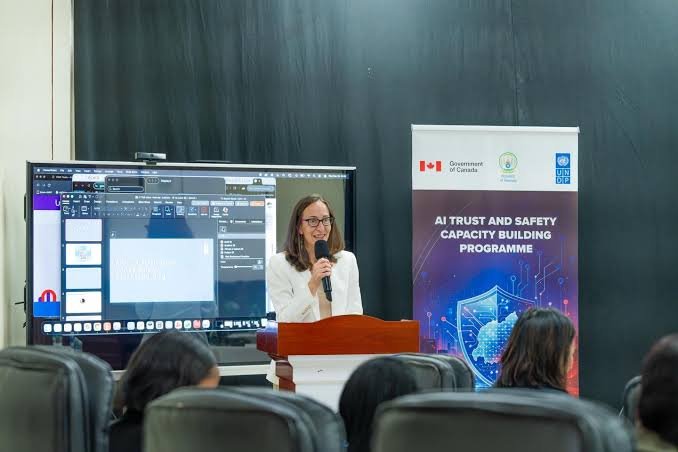
Rwanda hosted an AI Trust and Safety Workshop on March 23 that drew a pointed admission from one of the world’s most tech-forward nations: no country has fully figured this out yet.
Canada’s High Commissioner to Rwanda, Julie Crowley, told attendees that even countries with established AI strategies are still working out how to use AI safely and accountably in the public sector. She did not dress it up.
“AI should never be about speed at the expense of safety or automation at the expense of accountability,” she said.
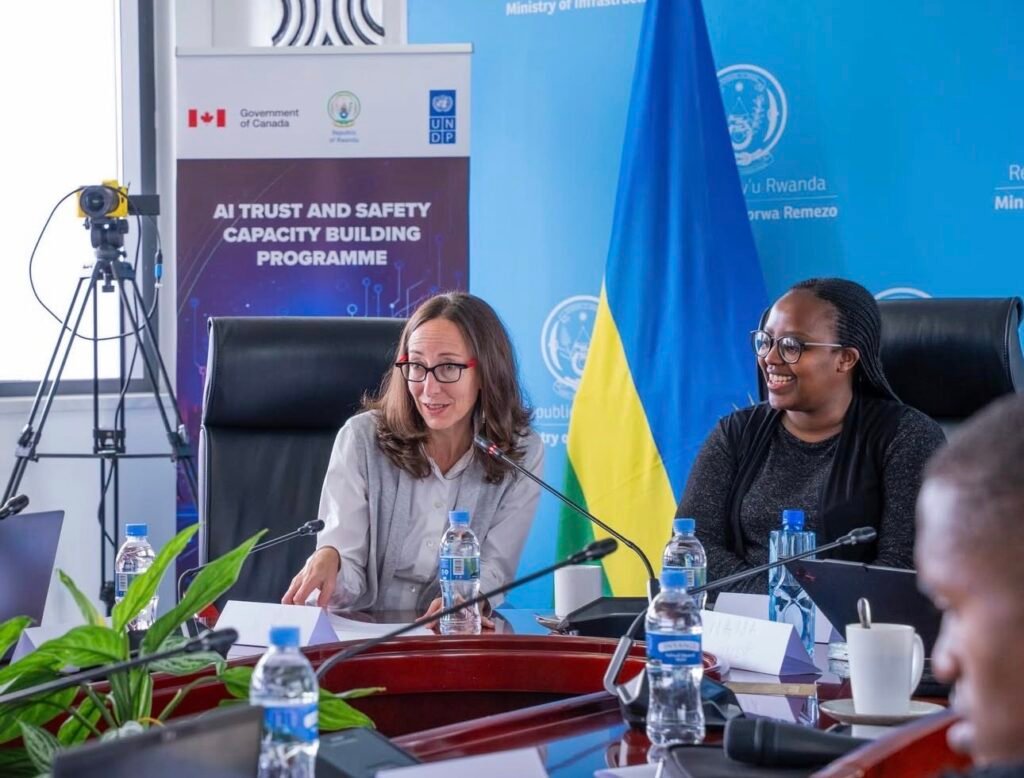
The workshop was organised by Rwanda’s Ministry of ICT and Innovation, co-hosted with UNDP Rwanda, and backed financially by the Government of Canada.
It brought together experts from finance, telecommunications, information technology, and cybersecurity — all focused on one question: how does a country build AI systems its citizens can actually trust?
UNDP’s Deputy Resident Representative in Rwanda, Nana Teiba Chinbuah, set the tone early. She told participants that AI risks are not a future concern — they are already emerging and evolving rapidly. The issue, she said, is not just technological. It is about trust, people, and the confidence citizens place in the digital systems that increasingly govern their lives.
Esther Kunda, Director General of Rwanda’s AI Authority, used the platform to outline how far the country has come.
Rwanda has been building AI literacy among public servants and is moving carefully on questions of bias, transparency, and how AI tools are deployed across government functions. The AI Authority itself is still relatively young — established with support from UNDP — which makes events like this less of a showcase and more of a working session.
The timing was deliberate. Just weeks after the workshop, Rwanda hosted the inaugural Global AI Summit on Africa in Kigali, where President Paul Kagame told more than 1,000 delegates from across the world that Africa must stop being just a market for AI and become an active player.
The March workshop was, in many ways, Rwanda doing its homework before making that argument on a continental stage.
For Africa, the approach Rwanda is modeling here is significant. Rather than deploying AI quickly and governing it later — which has been the pattern in many parts of the world — Kigali is building accountability frameworks first and pulling in global partners to help shape them.
Canada’s involvement signals that this is not just a domestic conversation. It is part of a broader effort to ensure that when African governments adopt AI in public services, there are guardrails already in place.
Rwanda’s National AI Policy, approved by Cabinet in April 2023, already commits to operationalising ethical guidelines and placing AI Ethics Officers inside government institutions. The harder work is turning those commitments into practice.
With the Africa Declaration on Artificial Intelligence now signed at the Kigali summit, and international partners watching closely, Rwanda has put itself in a position where the follow-through is no longer optional.
About the Author