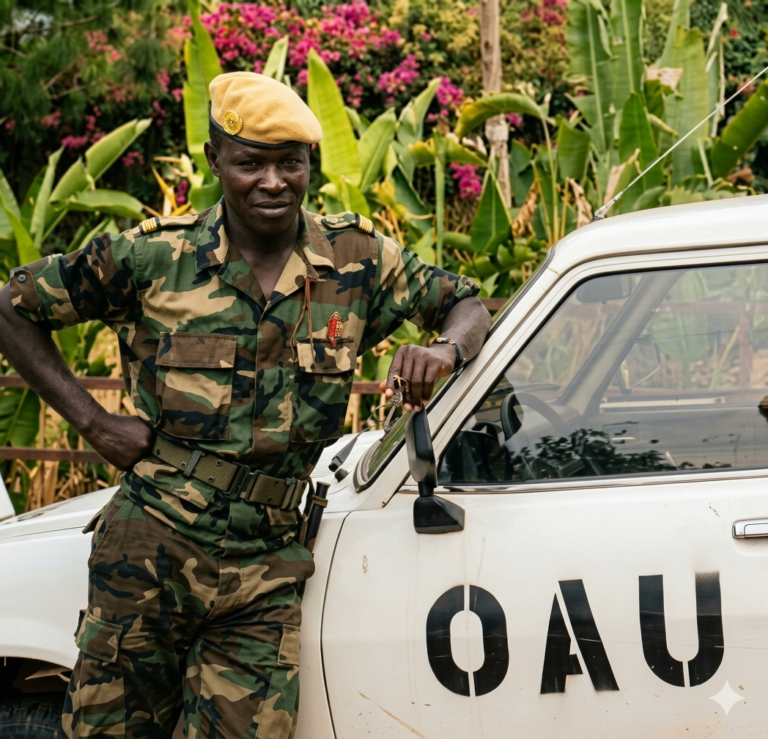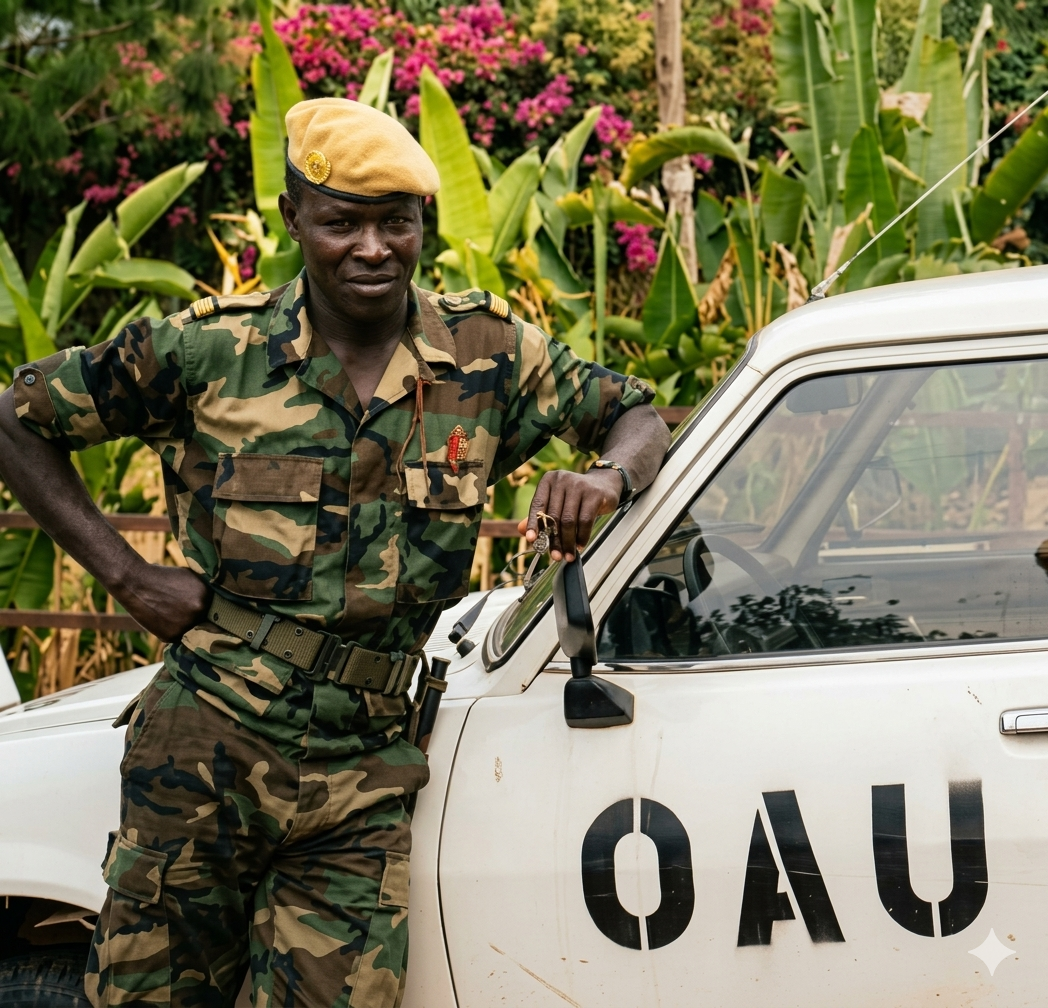
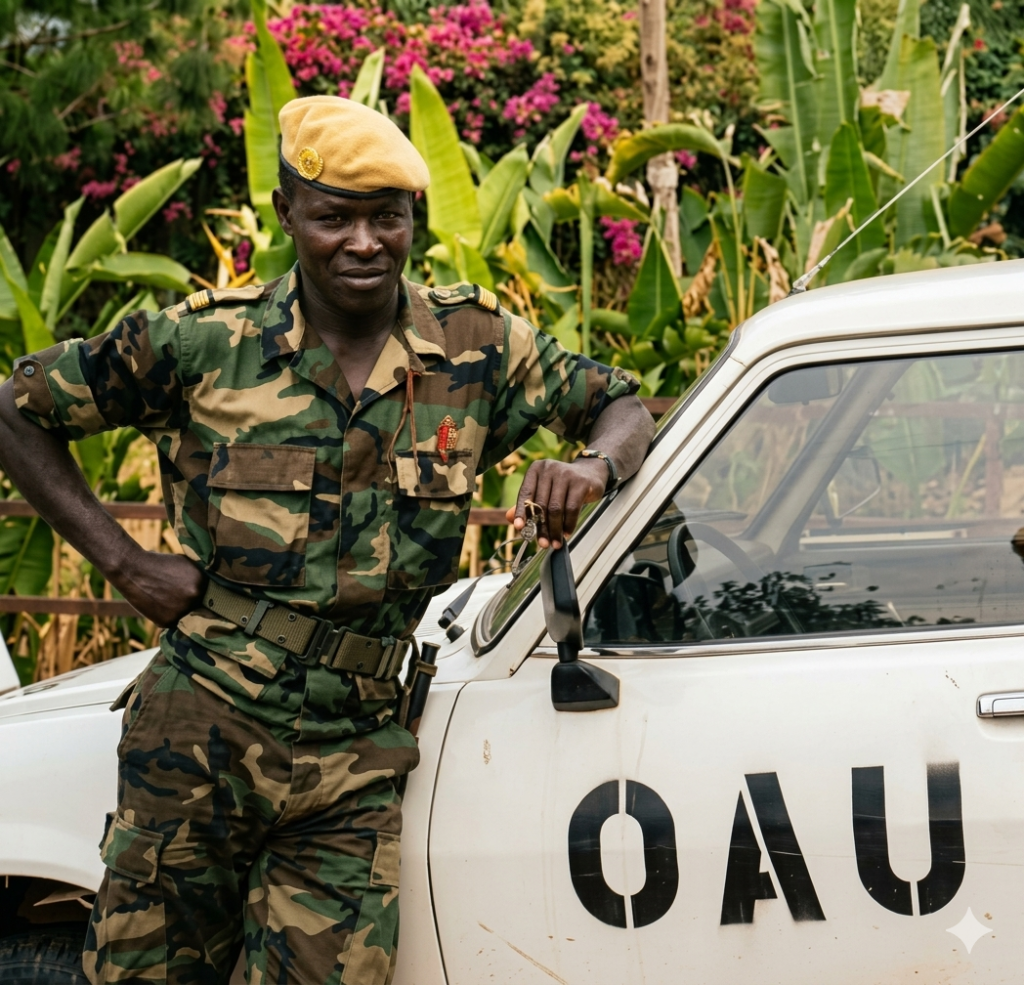
Late Capt.Mbaye is remembered every 31st May in Rwanda for his bravery.[Courtesy/Refined by Gemini]
When the world pulled its peacekeepers out of Rwanda in April 1994, one man drove back in, alone, unarmed, and again and again.
Captain Mbaye Diagne was a Senegalese military officer serving as a United Nations military observer with the UN Assistance Mission for Rwanda, UNAMIR. When the genocide began, most UN personnel withdrew. Diagne was part of the small group ordered to stay.
On the very first day of the genocide, April 7, 1994, Diagne rescued the children of Prime Minister Agathe Uwilingiyimana, a Hutu politician who had been killed that same morning, and brought them to safety. That was the beginning. Over the following weeks, he turned his white UN vehicle into a lifeline.
According to different testimonies, without weapons and with no backup, Diagne negotiated at militia checkpoints, sometimes relying on his charisma and dark humor to talk his way through transporting small groups of people hidden under blankets and household goods to safety, one carload at a time. His destination of choice was the Hôtel des Mille Collines, one of the few places in Kigali offering some degree of refuge.
General Roméo Dallaire, the Canadian force commander of UNAMIR, was aware that Diagne’s missions violated both his orders and the UN’s rules of engagement. He never moved to reprimand him. Dallaire would later call him “the bravest of the brave.”
The number of people Diagne saved has never been definitively confirmed. Estimates range widely: Dallaire credited him with protecting “dozens upon dozens,” while others put the figure at hundreds. The United States Department of State estimated he protected as many as 600 people. Academic Richard Siegler posited that he may have saved 1,000 or more.
On May 31, 1994, just 12 days before his assignment was due to end, Captain Diagne was killed instantly when a mortar shell landed near his vehicle while he was driving back to UNAMIR headquarters in Kigali. According to the UN, he was 36 years old. His wife, Yacine Mar Diop, was home in Senegal with their two young children, a daughter aged four and a son aged two.
It was the police who came to tell her, some 17 hours after her husband had died behind the wheel. His body took five more days to reach Senegal. When the UN Security Council unanimously voted in 2014 to create the Captain Mbaye Diagne Medal for Exceptional Courage, the first medal of its kind in UN history, it also acknowledged, with what it called “the deepest regret,” that his family had never received any expressions of appreciation from UN Headquarters following his death.
In 2010, President Paul Kagame awarded Diagne’s widow the Umurinzi, Rwanda’s Campaign Against Genocide Medal, in recognition of his courage during the genocide. Rwanda has since established an annual Mbaye Diagne Day, marked each year on May 31 at the Kigali Genocide Memorial.
According to Senegalese local media, The Chief of the General Staff of the Senegalese Armed Forces, General Mbaye Cissé, has confirmed that Diagne’s story is now formally integrated into the training of Senegalese soldiers before every deployment. “Before deployments and in training, we always tell our soldiers about the bravery of the late Captain Mbaye. It is an immense pride and responsibility he left for us as soldiers and peacekeepers around the continent,” General Cissé said.
As Rwanda marks Kwibuka 32 this month, the story of Captain Mbaye Diagne is not a footnote. It is a measure of what one person can do when institutions fail, and of what peacekeeping is supposed to mean when it matters most.
About the Author