Rwanda’s gender equality certification model, built from scratch and certified across 25 institutions, is now being positioned as a blueprint for the entire African continent with UNDP and the African Organisation for Standardisation leading the push.
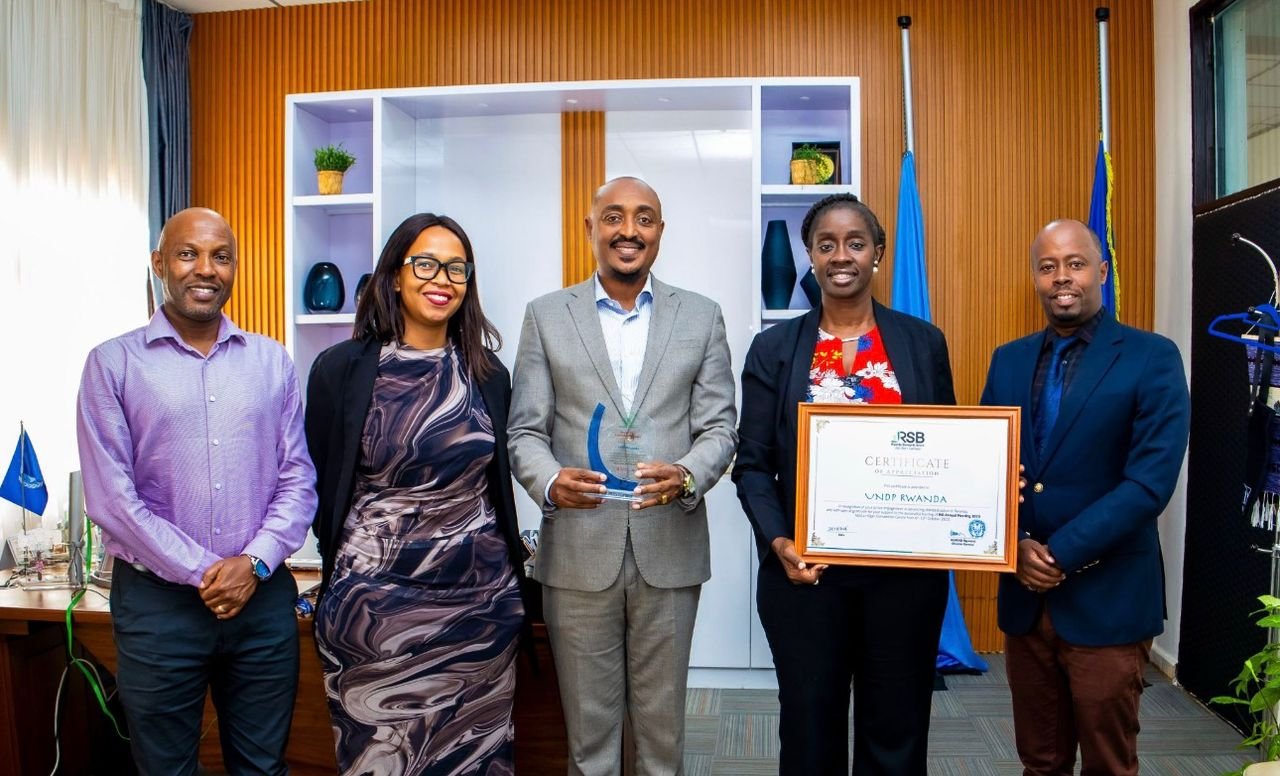
The Rwanda Standards Board Director General, Dr. Raymond Murenzi, met with UNDP Rwanda this week for a working session on RS 560:2023, Rwanda’s National Gender Equality Standard focusing on its implementation progress and continental expansion potential.
The meeting comes just months after Rwanda used the global stage of the ISO General Assembly in Kigali, in October 2025, to award the first formal certifications under the standard to 25 public and private institutions.
The timing of the UNDP-RSB meeting is deliberate. In October 2025, ISO and the African Organisation for Standardisation signed the landmark Kigali Agreement, establishing a framework to accelerate the adoption of international standards across Africa, a development that created real infrastructure for Rwanda’s gender standard to travel across borders.
RS 560:2023 was developed in partnership with the Rwanda Standards Board, the Gender Monitoring Office, UNDP, UN Women, and the Private Sector Federation, and elevates the Gender Equality Seal from a voluntary certification programme to a national accountability framework.
Engagement with ARSO is now underway to explore how the model can be adopted more broadly.
For Rwanda, this is more than a domestic policy win. RS 560:2023 sets benchmarks for fair recruitment, leadership representation, equal pay, and gender-responsive workplace systems, with accountability enforced through periodic certification .
The standard is also the first of its kind on the continent. Countries across Africa including Uganda, South Africa, the DRC, Zimbabwe, Ghana, and Nigeria are already working with public institutions to review internal practices and take steps toward building gender-responsive institutions .
Rwanda’s model gives them a tested framework to follow rather than building from zero.
What happens next is a continental certification race. With the Kigali Agreement now in force and ARSO actively engaged, the push will be to have RS 560 adopted as an African standard meaning governments, companies, and institutions across 54 AU member states could eventually certify against the same framework Rwanda pioneered.
UNDP’s Resident Representative in Rwanda described equality as something that must be built into the very systems and standards that guide societies, not treated as a separate goal . For Rwanda, that argument is no longer theoretical — it has 25 certified institutions and a continental body paying attention to prove it.
About the Author