
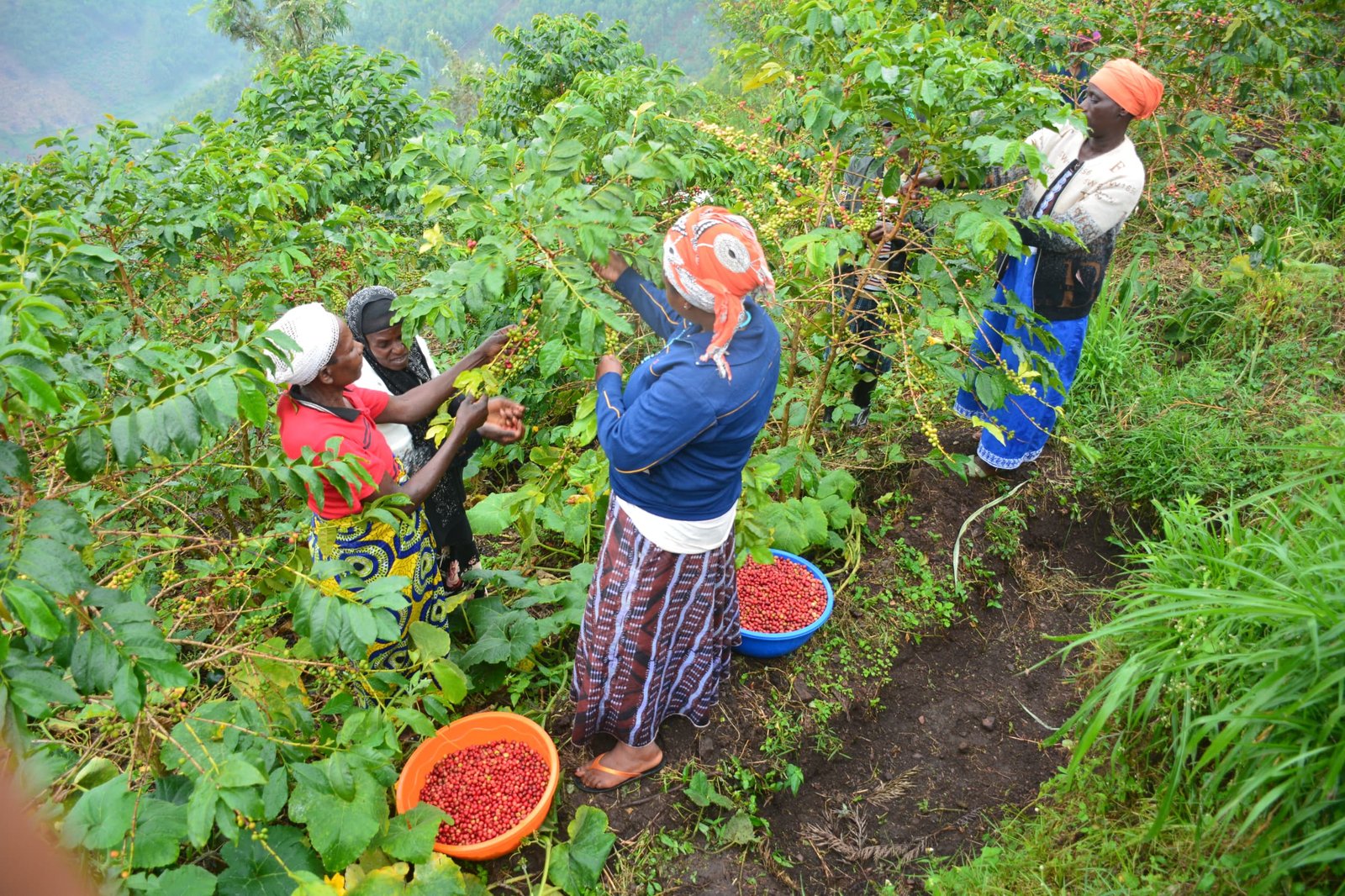
Rwanda’s coffee and tea sectors just posted their best numbers in history. But the money is not reaching the people who grow the crop.
Rwanda’s coffee exports hit a record $150 million in 2025, with volumes rising 39 percent year-on-year and revenues surging 65 percent. Add to that over $110 million earned from tea exports in 2023/24, and you are looking at a combined $255 million-plus generated from two crops that Rwanda’s hillside farmers wake up at dawn to tend.
The numbers are impressive, but the reality on the ground is far less so.
Rwanda’s export boards will tell you the farm gate price is improving and they are right on paper. In January 2026, Rwanda’s agricultural export authority raised the minimum price for coffee cherries by 25 percent to Rwf750 per kilogram, up from Rwf600 in 2025. That is a welcome move.
But Rwf750 per kilogram of raw coffee cherry, the least-processed, lowest-value form of the product is still a very long way from the premium prices that Rwandan single-origin coffee commands at specialty cafés in London, New York, and Tokyo.
The gap between what Rwanda earns and what farmers earn is not an accident. It is the architecture of the value chain.
More than 400,000 families grow coffee in Rwanda and rely on it as their main source of income. Those families face significant challenges, low and unpredictable yields, limited adoption of good agricultural practices, and inefficiencies at the washing stations where their cherries are initially processed.
On the tea side, the picture is similar. The formal tea sector supports over 60,000 workers and provides livelihoods to more than 45,000 smallholder farmers, yet 97 percent of the tea Rwanda produces is exported in raw, unprocessed form. Rwanda ships the raw material, someone else adds the value, and someone else pockets the margin.
This is the oldest story in African agriculture, and Rwanda is not immune to it.
To be fair, the government has not ignored the problem. Rwanda went from just two coffee washing stations in 2000 to more than 300 today, which pushed the share of fully washed, higher-quality coffee from 10 percent to over 65 percent of total production.
That was a genuine structural reform. The 2016 geographic zoning policy which tied farmers to specific washing stations to reduce the role of middlemen was another attempt to bring order to the chain, but it backfired.
The zoning policy inadvertently hampered market efficiency and limited farmer income by trapping them within zones that included underperforming washing stations, which were then guaranteed supply regardless of quality. NAEB eventually repealed it in June 2023.
Good intention, poor design, course correction. That is a pattern Rwanda’s agricultural policymakers need to break.
A human rights risk assessment conducted in Rwanda’s coffee sector identified the living income gap and gender inequality as the two highest-risk areas in the supply chain. The low income of coffee farmers is partly traced to aging coffee plants that reduce yields. Yet Rwanda’s response to aging trees has been slow, and replanting programs have remained patchy in rollout.
Meanwhile, approximately 80 percent of Rwanda’s tea is sold through auctions, a pricing mechanism that historically favors the buyer, not the farmer.
The core problem is this: Rwanda has built a world-class brand without building world-class farm-gate returns. Rwandan coffee wins international competitions. Rwandan tea reaches 48 countries, But the farmer in Gicumbi or Nyamagabe selling cherry at Rwf750 a kilogram is not living the story that brochures about “Rwanda specialty coffee” tell.
Rwanda’s agricultural strategy for 2024–2029 targets tea export revenues of $175 million from 58,600 metric tons of processed tea by 2029.
That is an ambitious, well-structured target, but the word to focus on is “processed.” The new tea strategy developed with FAO explicitly aims to increase value addition, diversify tea products, and reduce reliance on raw exports. If Rwanda moves even 20 percent of its tea exports from raw to processed and packaged form, the income retained in-country and potentially at farm level changes materially.
That is exactly the direction Rwanda must push harder and faster.
The same logic applies to coffee. Rwanda has the brand equity, it has the quality, what it needs now is a deliberate policy to capture more of the value chain from washing station to roasting to retail so that the $150 million in coffee revenue is not simply a government statistic but a felt reality in the households of 400,000 farming families.
About the Author