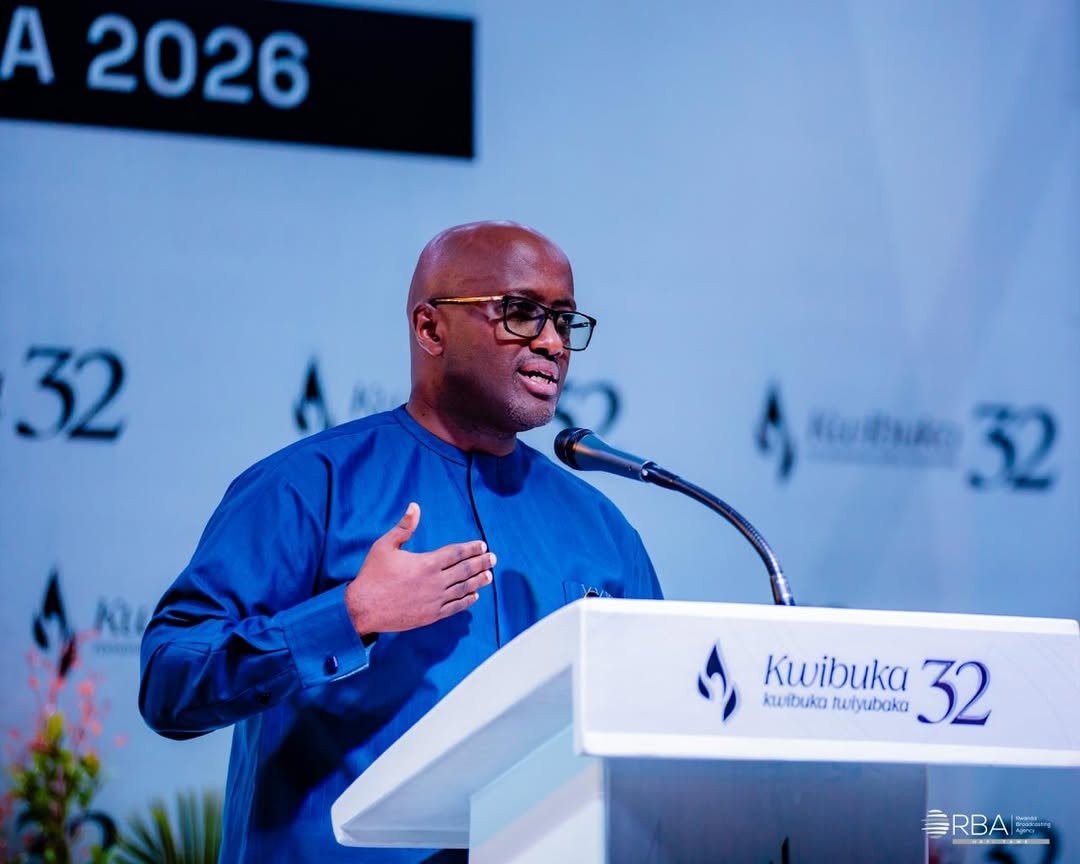
Four days into Rwanda’s 32nd commemoration of the 1994 Genocide against the Tutsi, the country’s most senior diplomat delivered a challenge that broke from the usual script.
Speaking on April 11, 2026, as keynote speaker at the official Kwibuka 32 evening ceremony at the Nyanza Genocide Memorial in Kicukiro, the site where more than 3,000 Tutsi were massacred after being abandoned by United Nations peacekeepers, Minister of Foreign Affairs and International Cooperation Olivier Jean Patrick Nduhungirehe turned Rwanda’s long-running justice demand away from European capitals and pointed it directly at the African continent.
The minister acknowledged that progress has been made. Countries that have prosecuted genocide suspects on their own soil, or transferred them to Kigali, deserve recognition, he said.
He credited several European nations by implication, French judicial authorities have referred Cyprien Kayumba, a former lieutenant colonel accused of supplying weapons used in the killings, to the Court of Assizes in Paris, and French courts are expected to begin the trial of another suspect, Safari Majariwa, later this year.
Belgium has secured convictions. The Netherlands has both tried suspects domestically and extradited others. Scandinavia has prosecuted cases under universal jurisdiction. Against that European backdrop, one country stands apart in the worst way. Minister Nduhungirehe stated that the United Kingdom remains the only European nation that has neither prosecuted a single genocide suspect nor transferred anyone to Rwanda.
The record is unambiguous. Five Rwandan genocide suspects have lived in the United Kingdom for nearly 25 years. Four court rulings were handed down between 2008 and 2017 at Westminster Magistrates Court and the High Court. The suspects successfully argued against extradition over eleven years and have since 2017 continued legally untroubled by the crimes they are alleged to have committed.
France and Belgium are among the countries that have already held trials, while Britain has been accused of lagging behind other nations. A 69-year-old Rwandan suspect was arrested in Gateshead in January 2024, but no trial has followed. The minister’s sharpest words, however, were not for London.
Of the more than 1,100 arrest warrants Rwanda’s Prosecutor General has issued for suspects living abroad, Nduhungirehe told the Nyanza audience, the majority are directed at individuals living on African soil not in Europe. And the number of African states that have responded, either by conducting their own prosecutions or by extraditing suspects to Kigali, is, in his words, very small.
African countries, the minister said plainly, have let Rwanda down. He called on them, directly and without diplomatic softening, to act on the outstanding warrants. The geography of that impunity has deep roots. Government officials, soldiers, and militia who participated in the genocide fled to the Democratic Republic of Congo, then known as Zaire, taking with them more than 1.4 million civilians, according to official records.
The camps they established were subsequently used by former Rwandan government soldiers to re-arm and stage incursions back into Rwanda. The genocidaire militia known as the FDLR emerged from those camps and still takes refuge in the DRC thirty-two years later. Most African states have no extradition treaty with Rwanda. Several maintain diplomatic relationships with Kigali that range from cool to openly contentious.
Rwanda’s Prosecutor General’s outstanding warrants fall entirely outside the International Residual Mechanism for Criminal Tribunals list , meaning no multilateral enforcement exists — every warrant depends on bilateral goodwill that has largely not materialised across the continent. The one prominent African case to have reached a court came from South Africa.
Fulgence Kayishema, accused of ordering the massacre of 2,000 Tutsi refugees at Nyange Catholic Church, was arrested in 2023 on a grape farm in Paarl, having spent more than two decades as a fugitive under the false identity of Donatien Nibashumba. He remains in South African detention while his legal team pursues every available avenue to block transfer to Rwanda. His case is the exception not the rule.
The choice of venue for Nduhungirehe’s statement carried its own weight. The Nyanza Genocide Memorial in Kicukiro is where the international community’s failure in 1994 is not abstract, it is buried in mass graves. More than 3,000 of the approximately 105,000 victims interred there were killed on that specific site after being abandoned by the UN mission for assistance in Rwanda.
Directing a call for African accountability from that ground, before survivors and the diplomatic community, was a deliberate signal. President Paul Kagame, speaking at the national ceremony on April 7, had already set the tone: justice cannot be fully realised while perpetrators remain at large, and Rwanda’s call for international cooperation must be answered.
Whether African governments respond will determine whether the minister’s public rebuke produces results or becomes another appeal without consequence. What changed at Nyanza on April 11 is the direction of the demand — and Rwanda is no longer prepared to keep that frustration quiet.
About the Author