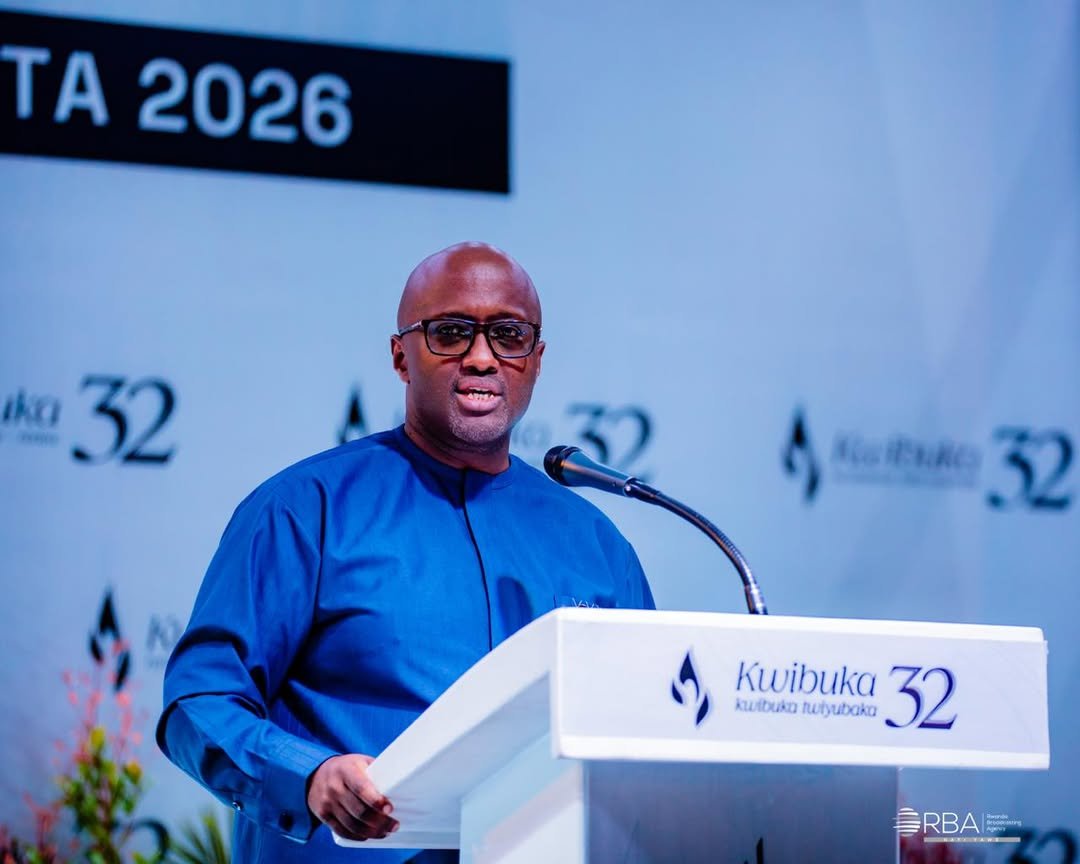
Speaking at the Nyanza Genocide Memorial in Kicukiro, on the south-eastern edge of Kigali, Rwanda’s Minister of Foreign Affairs and International Cooperation, Olivier Jean Patrick Nduhungirehe, delivered one of the most direct accusations his government has made publicly in recent years: the Democratic Republic of Congo is not simply engaged in a regional military dispute with Rwanda, it is working to bring genocide back.
The minister spoke on April 11, 2026, the date held each year in Rwanda to mark a specific and devastating chapter of 1994. It was on April 11 of that year that Belgian United Nations peacekeepers stationed at the École Technique Officielle, a technical school on the outskirts of Kigali in Kicukiro, withdrew their forces, abandoning at least 2,000 Rwandans, including 400 children who had sought their protection on the school grounds.
Those who had taken refuge were then marched to Nyanza, where they were killed. Today, the site holds the remains of more than 105,000 victims, and a memorial ceremony is held there every April 11 without exception. Nduhungirehe’s choice of this location, on this date, to deliver these remarks was not incidental. It was a deliberate act of framing: the international community failed Rwanda once.
His government’s argument is that the conditions for that failure are being rebuilt, this time from Kinshasa. The minister’s case rests on two pillars. The first is the continued presence and state-backed empowerment of the Democratic Forces for the Liberation of Rwanda, known by its French acronym FDLR. The FDLR is a militia founded by perpetrators of the 1994 Genocide against the Tutsi, during which more than one million people were killed in approximately 100 days.
Nduhungirehe has consistently called on the Congolese government to neutralize the FDLR in good faith, noting that its fighters are not only embedded within the Congolese national armed forces known as the FARDC, but are actively spreading genocide ideology through those military structures and across the broader region.
For Kigali, this is not a distant concern. Rwanda’s stated position, as published by the Ministry of Foreign Affairs, is that ending Congolese state support for the FDLR and ensuring their demobilization and repatriation to Rwanda is a non-negotiable requirement to protect Rwanda’s territorial integrity and guarantee the preservation of national unity for future generations.
The second pillar is more politically charged. President Paul Kagame, in an interview with French magazine Jeune Afrique published in early April, stated that Congolese President Félix Tshisekedi is using Jean-Luc Habyarimana, son of the late former Rwandan president Juvénal Habyarimana to rally international opinion in support of the FDLR and to build a support network in France and beyond.
Former President Habyarimana led Rwanda from 1973 until his assassination on April 6, 1994, the event that immediately preceded the start of the genocide. His wife, Agathe Kanziga, has been accused by Rwanda and by investigators in multiple jurisdictions of being a central figure in the Akazu, the inner circle believed to have engineered the killing campaign.
She has lived in France since 1998 despite repeated extradition requests from Kigali, and a French court has now postponed a ruling on her case to May 6, 2026. According to analysis published in The New Times, Jean-Luc Habyarimana serves as treasurer of Jambo ASBL, the FDLR’s primary fundraising organization, which operates out of Belgium, and recently met with President Tshisekedi in Kinshasa as part of what the article describes as efforts to strategize against Rwanda’s government.
Nduhungirehe described it as extraordinary that, nearly 32 years after a genocide recognized by international judicial mechanisms and the United Nations, denial and minimization of the Genocide against the Tutsi continues to be actively promoted, a reference to Agathe Kanziga, whose recent interview was released under a history-framing hashtag and made no acknowledgment of the genocide itself.
The minister’s position is that no government can promote or politically elevate members of this family while simultaneously arming and integrating the FDLR into its national military without carrying an agenda that points in one direction. Congo’s Information Minister Patrick Muyaya has rejected the characterization entirely, describing Jean-Luc Habyarimana as a political figure who advocates for peace and reconciliation, and dismissing Rwanda’s stated concerns as lies used to justify what Kinshasa calls illegal actions in eastern Congo.
The two governments are, in effect, operating from incompatible definitions of what is happening: Kinshasa frames the conflict as Rwandan aggression and illegal occupation; Kigali frames it as existential self-defense against a genocidal force that has never been dismantled. The backdrop to both positions is a peace agreement that remains visibly incomplete.
Rwanda and Congo signed a Washington-brokered agreement last June, with Kinshasa committing to dismantle the FDLR and Kigali committing to disengage its forces, but fighting has continued on multiple fronts since signing. On March 30, Congo’s army announced the start of a disarmament push, deploying a senior general to the northeastern city of Kisangani to begin preparations though the initial phase was described as focused on persuading fighters to surrender voluntarily.
Rwanda has made clear that voluntary persuasion is not the standard it has in mind.
What comes next will be shaped by three converging moments. The French court’s ruling on Agathe Kanziga on May 6 will signal whether the international legal system is prepared to hold figures connected to the genocide’s planning accountable, or to let those cases close quietly.
The implementation or continued non-implementation of the FDLR disarmament commitment will determine whether the Washington agreement holds any meaning on the ground. And the diplomatic context of Kwibuka 32, Rwanda’s 32nd genocide commemoration now underway, puts every government in the region on notice that Kigali is watching whose silence speaks loudest.
Nduhungirehe delivered his warning at a site where thousands were abandoned to be killed. His message on April 11, 2026, was that the architecture of abandonment is being reconstructed and this time, Rwanda will not wait for the peacekeepers to leave.
About the Author