Rwanda’s National Defence University is no longer a proposal sitting on a desk somewhere. The institution has a governance structure, a legal foundation passed by parliament, and a Chancellor, President Paul Kagame himself.
The first students are expected to walk through its doors in September. Eight years after the idea was first raised inside the Rwanda Defence Force, the country is about to have a military university of its own.
The National Defence University is a specialised institution designed to integrate education, professional training, and research in the fields of national defence and security. It will offer higher education programmes leading to academic degrees, professional certificates, and other qualifications in defence and security-related disciplines.
That may sound like a bureaucratic description, but the ambition behind it is significant.
Until now, senior Rwandan officers seeking advanced strategic education had to go abroad — to Kenya’s National Defence University, the US National Defense University in Washington, or through partnerships with civilian institutions like the University of Rwanda.
The degrees currently issued by the University of Rwanda for military personnel will transition to degrees issued by the National Defence University, which will encompass the existing military schools alongside a research centre and a peacekeeping studies centre.
The structure: one university, many institutions
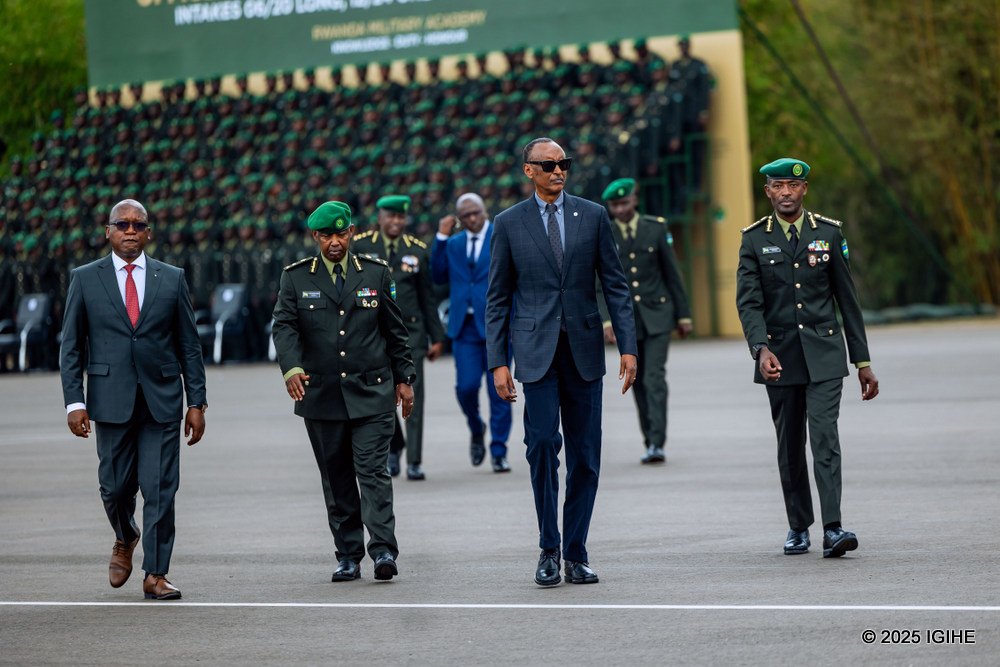
The NDU will combine several existing Rwanda Defence Force facilities. The Rwanda Military Academy in Gako will provide undergraduate programmes in military and social sciences, general medicine with a military focus, and long-course officer training.
The RDF Command and Staff College in Nyakinama, Musanze, will offer mid-to-senior level courses in command, staff management, and defence policy.
A new National Defence College will serve as the highest level for senior leadership development, targeting colonels and brigadier generals with advanced training in strategic defence policy, international security, leadership, command, and management areas that were not available before at a national level.
Another key feature of the new university is the consolidation of colleges and academies of the Rwanda Defence Force, Rwanda National Police, and the National Intelligence and Security Service.
Bringing these training institutions under one university framework is expected to enhance coordination, professional development, and academic standards across the country’s entire security sector. The bill also underscores the promotion of values-based thinking alongside academic and professional training.
Supporting institutions feeding into the university include the RDF Combat Training Centre in Gabiro, the Non-Commissioned Officers Academy, the School of Infantry, the Cadet Training Academy, the Special Forces Training School, and the Peace Support Operations Training School.
President as Chancellor: a deliberate signal
The decision to name President Kagame as Chancellor of the NDU is not merely ceremonial. It follows a precedent well established in the region Kenya’s President William Ruto holds the same role at NDU-Kenya, but in Rwanda’s context it carries additional weight.
The Commander-in-Chief of the Rwanda Defence Force is, by constitution, the President of the Republic. Command is centralized under the President, with a Joint Headquarters overseeing the various service chiefs and specialized commands.
Making Kagame Chancellor of the NDU anchors the university directly within that command chain, signalling that this is not a standalone academic project but a core element of how Rwanda conceptualises military power and strategic leadership.
It also reflects the depth of Kagame’s personal involvement in the RDF’s transformation. He was the military commander who rebuilt Rwanda’s army from nothing after 1994. That the institution meant to produce the next generation of strategic thinkers carries his title at the top is a statement of continuity and intent.
Eight years in the making
The idea for the NDU began in 2018, when RDF leaders consulted international partners, including the United States National Defence University, to plan a modern institution.
By 2024, the Ministry of Defence had presented the project to Parliament, emphasising the need for higher-level training to produce flexible and capable leaders. A law passed in 2024 referenced the creation of a Defence University, paving the way for a subsequent Cabinet decision.
Curriculum development and partnerships with the University of Rwanda over the past year then prepared the university for launch.
The bills were passed during a March 11, 2026 plenary sitting of the lower chamber of parliament, alongside a revised bill governing the National Intelligence and Security Service. They were awaiting presidential assent and promulgation in the official gazette.
Defence Minister Juvenal Marizamunda has been one of the project’s most consistent advocates.
When the bill was presented to the Deputies’ General Assembly in 2024, Minister Marizamunda explained that the reforms aimed to improve RDF governance to effectively fulfil its duty of safeguarding national security. He noted that the need for additional military leaders was based on the increasing responsibilities of the RDF due to its various international activities, and that the reforms were made in response to current global and regional security dynamics.
Why Rwanda needs this now
The timing is not accidental. Rwanda’s military is arguably the most active on the African continent relative to its size, and the demands on its officer corps are expanding fast.
The Rwanda Defence Force underwent a comprehensive structural reorganisation in August 2025. The current framework consists of four service branches: the Rwanda Land Force, the Rwanda Air Force, the Rwanda Reserve Force, and the newly established Military Health Service.
The RDF maintains an active personnel strength of approximately 35,000. The primary strategic trend is professionalization and the refinement of its expeditionary model, reflected in 2025 military promotions that affected over 21,000 personnel and aimed to institutionalise leadership continuity.
Between 6,000 and 9,000 of those personnel are deployed in peacekeeping and bilateral security missions at any given time in South Sudan, the Central African Republic, Mozambique, and elsewhere.
Rwanda has positioned itself as an alternative security partner, sending bilateral missions across the continent as French direct military operations in Africa ceased and UN peacekeeping operations began withdrawing from key missions. Rwanda funds a substantial portion of its national defence budget through contributions from UN peacekeeping missions.
That model only works if the officers leading those missions are trained to the standard the missions demand. Sending them abroad to get that training is expensive, slow, and means Rwanda’s strategic curriculum is shaped by someone else’s priorities.
The National Defence University will now grant these degrees internally, ensuring the training is specifically tailored to Rwanda’s unique security context and regional challenges.
A regional ambition, not just a national one
Slated to welcome its first cohort in September 2026, the university is being positioned as a premier centre of excellence for the Great Lakes region.
Beyond teaching military tactics, the institution is tasked with developing leaders capable of navigating complex global geopolitics and modern peacekeeping requirements.
Defence officials emphasise that while the university will maintain academic independence and seek international research partnerships, its primary goal is to foster a homegrown generation of strategic thinkers who can safeguard national sovereignty while contributing to continental stability.
That language “Great Lakes region” is deliberate. Rwanda already trains officers from friendly countries at its existing Command and Staff College in Nyakinama.
Once the NDU is operating at full capacity, that regional intake is likely to grow. Kenya’s NDU hosts officers from Burundi, Egypt, Tanzania, Uganda, Rwanda itself, and more. Rwanda will now be in a position to reciprocate and expand.
The RDF Command and Staff College recently launched an International Relations and Security Course, the first in a new series of strategic-level programmes attended by participants from the RDF, Rwanda National Police, National Intelligence and Security Service, and Rwanda Correctional Service, with the launch attended by representatives from Euclid University, the University of Rwanda, and other higher learning institutions. That course is a preview of what the NDU will formalise at a higher level.
September 2026 is the target for the first student cohort. Between now and then, the law must receive presidential assent, be published in the official gazette, and the governance structure with Kagame as Chancellor must be formally constituted.
Programs will include bachelor’s degrees in military fields, mid-level command courses, and postgraduate studies in defence policy, international relations, security, and leadership. The university may also develop research facilities and partnerships with other agencies and international institutions.
The NDU will reduce the need for RDF officers to study at civilian or foreign universities and will help build a professional, disciplined military that can protect Rwanda’s sovereignty and support regional stability.
For a country that rebuilt its military from the ground up after 1994, a nationally accredited defence university with the Commander-in-Chief at the top is not a small thing. It is the institutional expression of an army that no longer borrows its credentials from somewhere else.
About the Author