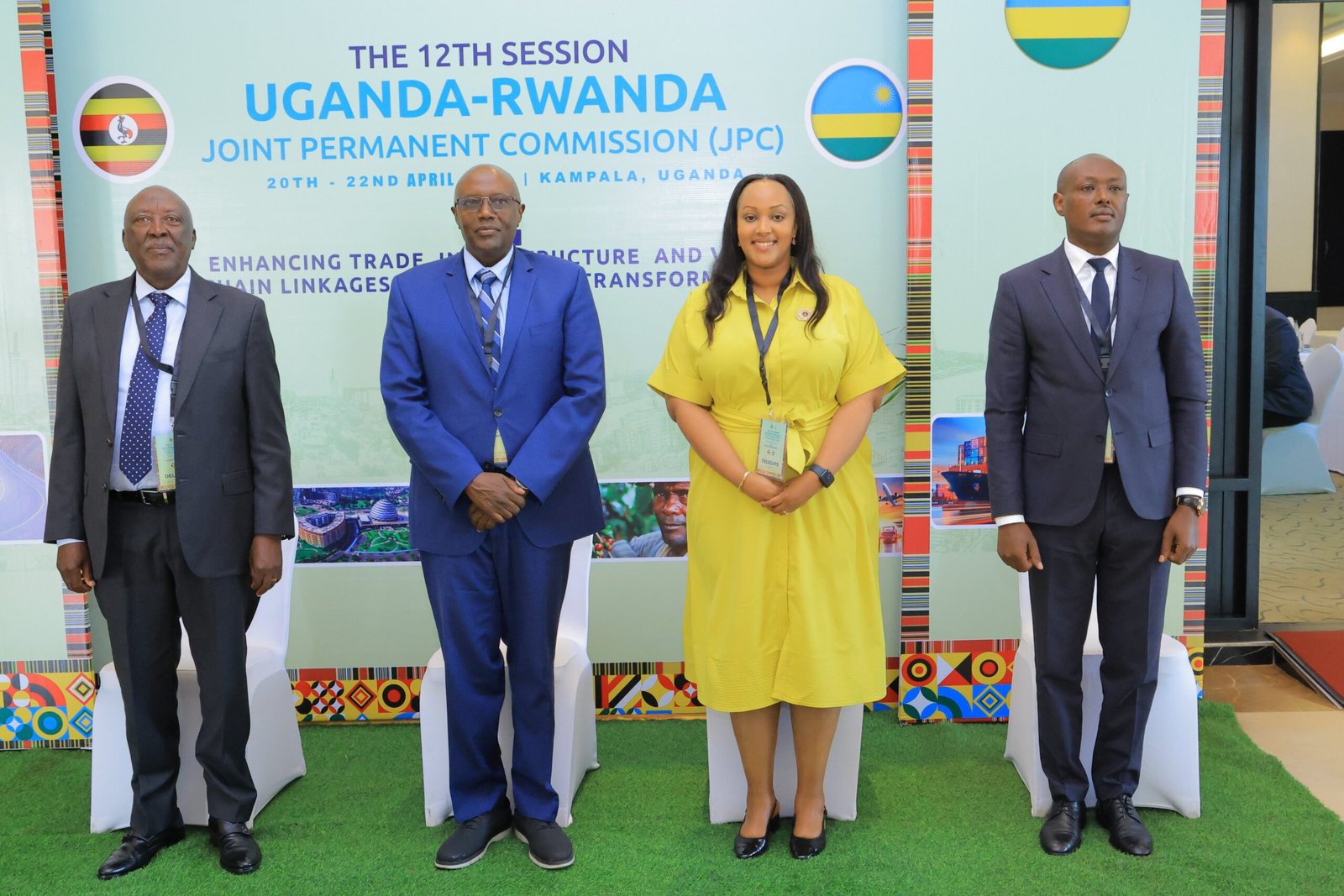
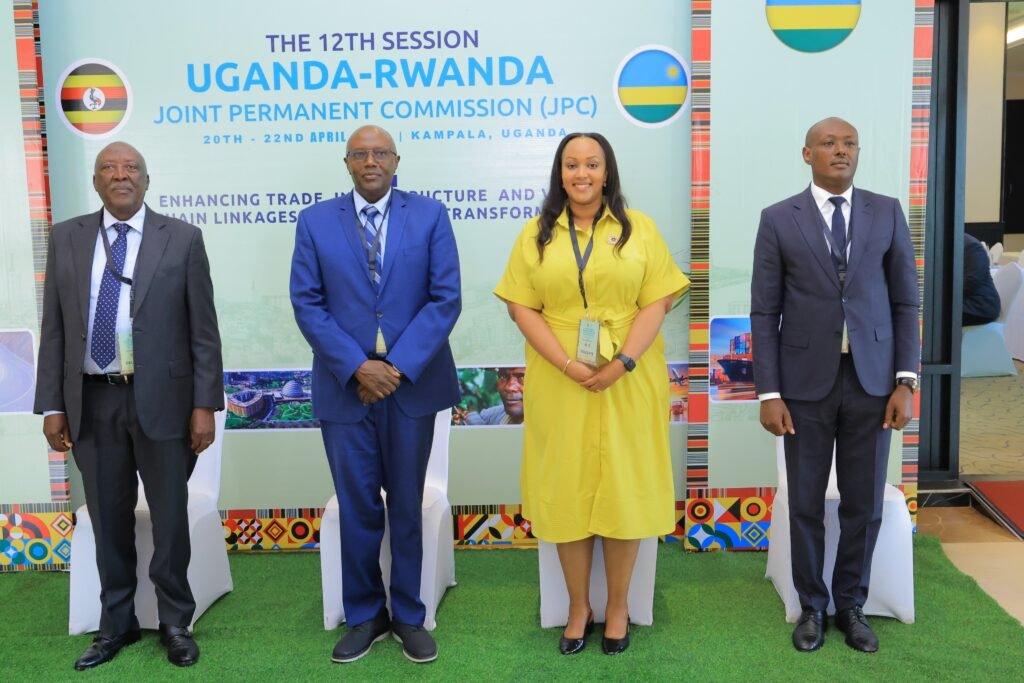
Senior officials from Uganda and Rwanda opened discussions Monday on ways to deepen cooperation in infrastructure, trade facilitation, and other key sectors, as the 12th session of the Uganda-Rwanda Joint Permanent Commission got underway at the Mestil Hotel in Kampala.
Rwanda’s delegation is led by Teta Gisa, Director General for Africa at Rwanda’s Ministry of Foreign Affairs, with Uganda’s side led by Ambassador Richard Kabonero, Head of the Regional Economic Cooperation Department.
The ministerial segment where outcomes will be formally adopted and new memoranda of understanding signed will be led by Rwanda’s Minister of State for Foreign Affairs Dr. Usta Kaitesi and Uganda’s Minister of State John Mulimba.
The three-day meeting runs April 20–22 and brings together more than 15 ministries and agencies from both countries to review progress since the last session held in Kigali in March 2023. That gap of over three years matters.
The JPC framework itself was born out of necessity in August 2019, Presidents Kagame and Museveni signed a peace agreement in Angola to end years of mutual accusations of espionage, political assassinations, and trade conflicts, and the commission became the primary instrument for rebuilding the relationship brick by brick.
What’s on the table reflects how much ground both sides want to cover.
Discussions will focus on defence and security, cross-border infrastructure, migration management, police cooperation, and education and human capital development.
The trade numbers give a sense of the asymmetry still present in the relationship: provisional data for September 2025 shows Uganda’s monthly exports to Rwanda at $22.37 million, comprising agricultural produce, plastics, and construction materials, while Rwanda’s exports to Uganda stood at approximately $1.2 million, made up largely of sugar, cement, and maize flour.
That near 19-to-1 gap is a known pressure point and one Rwanda will likely seek to rebalance through the new MoUs expected to emerge from the session.
Both sides view the commission as evidence of strong fraternal relations and a shared commitment to advance bilateral ties in line with the East African Community integration agenda and the African Union’s Agenda 2063.
Once the ministerial segment closes on April 22, the focus will shift to implementation of the persistent weak link in the JPC’s history. Rwanda will be watching whether agreements on transboundary infrastructure and migration, in particular, translate into concrete timelines rather than another three-year gap before the 13th session.
About the Author