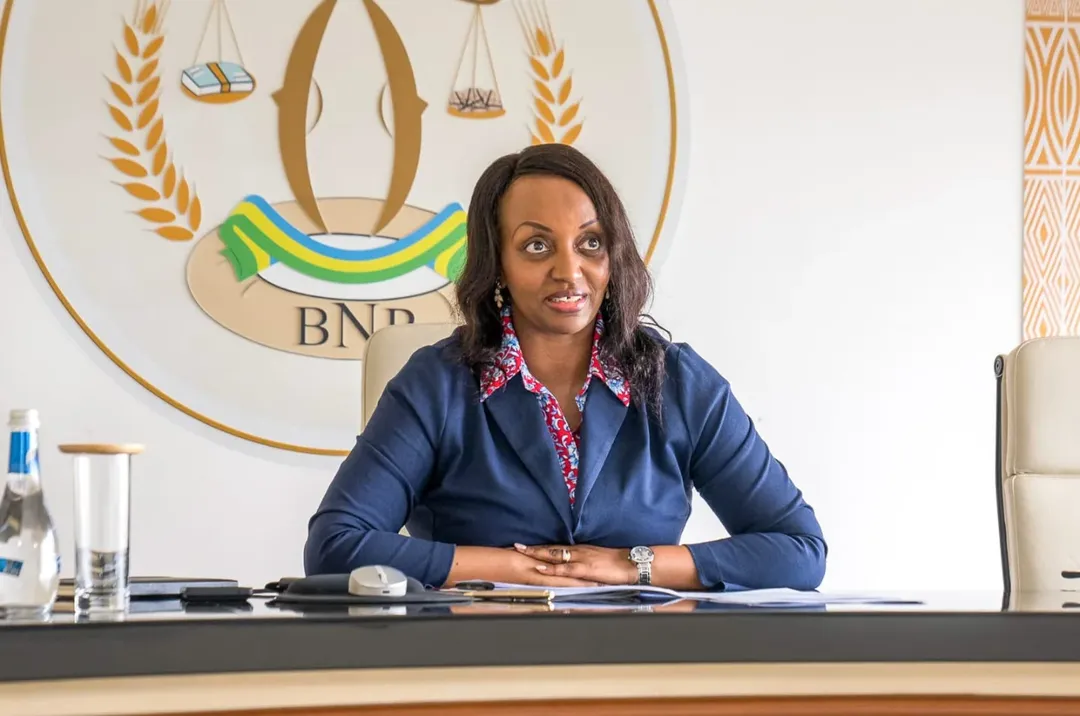
National Bank of Rwanda Governor Soraya Hakuziyaremye has given a detailed account of how Rwanda brought inflation down from a record 21 percent in Q4 2022 to 4.8 percent by 2024.[Courtesy]
Rate hikes, government subsidies, and a coordinated multi-institution response that brought inflation back to 4.8%.
Rwanda’s inflation spiked to around 21 percent in the final quarter of 2022, the highest on record and the National Bank of Rwanda raised its benchmark policy rate by three percentage points while the government simultaneously subsidized fuel, transport, and fertilizer. By 2024, headline inflation had fallen back to 4.8 percent. The Governor of the NBR has now given the most detailed public account of how that recovery was engineered.
“It’s not one institution only, but those multiple institutions and really the coordinated effort at government level where on a daily basis you’re assessing the situation that made us weather the storm, I would say, without panic.” She said during the long form podcast appearance
Speaking on the Long Form Podcast, National Bank of Rwanda Governor Soraya Hakuziyaremye described the 2022 crisis as the convergence of two simultaneous shocks: the Russia-Ukraine war drove energy prices sharply higher from February of that year, while Rwanda’s agricultural production had been moderate, tightening domestic food supply at exactly the wrong moment.
“What had happened was energy, because of the war in Ukraine that started in February, oil prices were high, but our agricultural production had been moderate,” she said. The central bank’s immediate response was a rate hike to cool demand, while government intervened on the supply side to keep essential goods affordable.
Rwanda’s NBR Governor Soraya Hakuziyaremye described a standing institutional principle: no single body can solve an inflation crisis. “No institution can solve a crisis alone. Inflation requires coordinated efforts for all levels of government, but also from the citizens and the businesses,” she said.
The Ministry of Agriculture was directed to increase food production for the following season. International channels were activated to secure continued wheat exports from Ukraine despite active conflict. The government subsidized transport, fuel, and fertilizers. The central bank raised its rate by three percentage points and monitored the transmission through the banking system.
Rwanda entered the 2022 crisis with an institutional advantage: it had navigated COVID-19 without panic and had already built cross-government coordination mechanisms for economic shocks. The Governor credits that history of crisis management and Rwanda’s political structure for the calm the central bank was able to maintain while inflation was at record levels.
Other economies in Sub-Saharan Africa hit comparable or higher inflation peaks during the same period, some without the fiscal space to subsidize essentials or the institutional coordination to manage recovery.
Inflation has risen again. It reached 8.9 percent in January 2026 and the NBR has raised its rate again this time by 50 basis points to 7.25 percent. Whether the 2022 playbook holds in a new tightening cycle will depend on whether the current pressure is demand-driven or as in 2022 supply-driven. The Governor’s answer to that question will shape NBR policy for the rest of the year.
About the Author