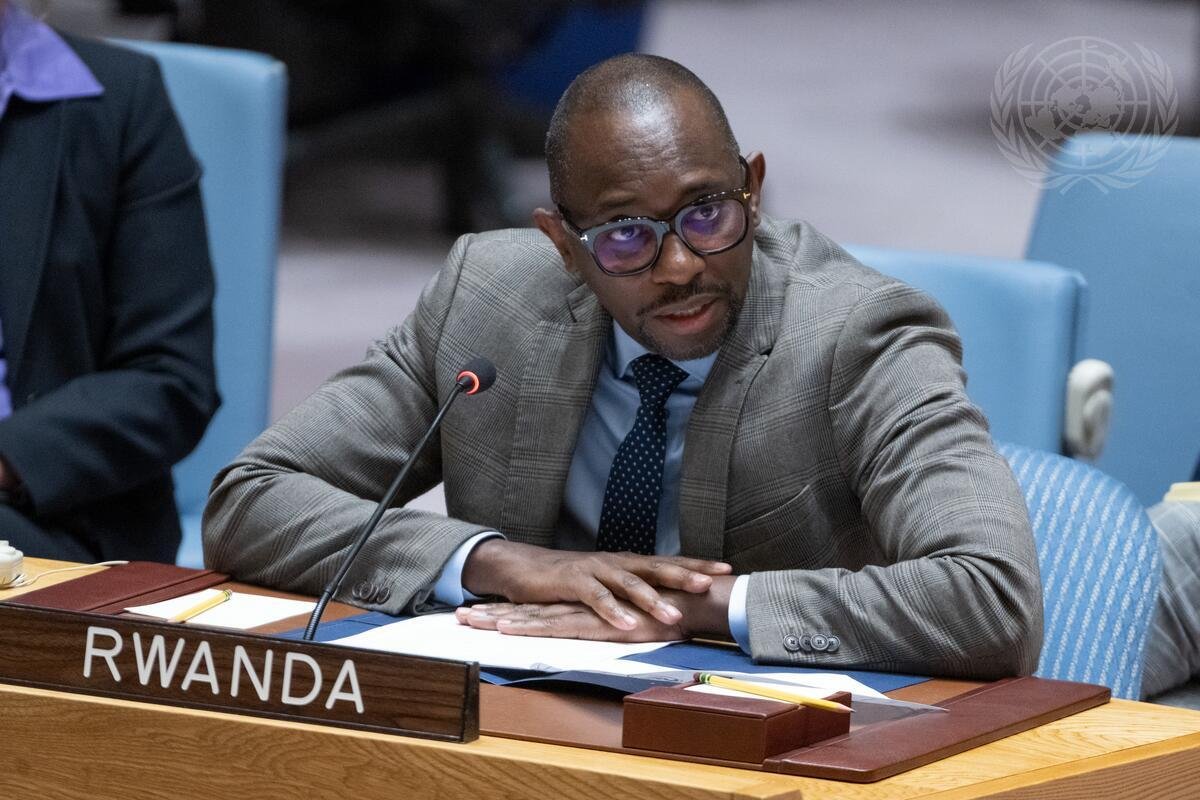
Rwanda’s deputy ambassador to the United Nations delivered a blunt message to the Security Council on Wednesday, April 15, that no peace framework in eastern DRC will hold as long as the FDLR continues to operate freely.
Robert Kayinamura, Rwanda’s Deputy Permanent Representative to the UN, addressed the Security Council during its session on the 2013 Peace, Security, and Cooperation Framework, reiterating the importance of disarming and neutralizing the FDLR and its splinter groups, condemning hate speech, xenophobia, and ethnic incitement in the DRC, and calling for greater regional and international support for peace efforts.
In some of the session’s sharpest language, Kayinamura drew a direct line from the FDLR’s continued presence to the collapse of every ceasefire attempt in the region. “Entertaining or legitimizing the FDLR, even tacitly, prolongs the conflict and destabilizes the region further,” he told the Council.
He also called out the DRC government directly, highlighting that militia-linked ceasefire violations by the Wazalendo demonstrated a lack of political ownership by Kinshasa.
The session was the Security Council’s biannual review of the 2013 Peace, Security and Cooperation Framework with UN Special Envoy for the Great Lakes Region Huang Xia expected to brief Council members on recent developments, including the Doha Framework signed in November 2025 and the Washington Accords agreed in March 2026.
Under those Washington Accords, reached on March 18, the two sides agreed to a series of coordinated steps, including a time-bound and intensified effort by the DRC to neutralize the FDLR, linked to a phased lifting of Rwanda’s defensive measures.
Rwanda’s position at the Council on April 15 made clear that Kigali sees FDLR neutralization not as one item on a checklist, but as the defining test of whether Kinshasa is serious about peace.
The US echoed that demand at the same session. The American delegation called on the DRC government to follow through on its commitments to immediately neutralize the FDLR, at least in the areas under its control, describing this as essential to breaking the cycle of mistrust that has fueled the conflict for decades.
Washington also disclosed that it had imposed targeted sanctions the previous month on the Rwanda Defense Force and four senior RDF generals, a move Kigali has consistently pushed back against as a misrepresentation of the ground reality.
The FDLR is not an abstract security concern for Rwanda. The group was founded by people who fled Rwanda after participating in the 1994 genocide that killed one million Tutsis, and the DRC has continued to use FDLR fighters as proxies despite committing to arrest soldiers who cooperate with the group.
The timing also matters. Kwibuka 32, Rwanda’s annual genocide commemoration, making the FDLR issue impossible to separate from Rwanda’s national memory and its security doctrine.
Kayinamura closed his remarks by framing Rwanda’s goal in historical terms: Rwanda looks forward to working with all partners to transform the Great Lakes region into a zone of peace and stability, and to permanently get rid of the legacy of genocide.
The March 2026 Washington Accords established a joint implementation timeline, with the DRC committing to measurable progress on FDLR neutralization in exchange for Rwanda easing its defensive measures in defined areas of DRC territory.
Whether Kinshasa delivers on that commitment is the question now before the region. Rwanda has made its sequencing clear: verification comes before withdrawal. The Security Council’s next Great Lakes review, scheduled for October, will be the first real audit of whether either side has moved from words to action.
About the Author