The killers had a plan for the bodies. They called it a shortcut. Throw the victims into the Nyabarongo River, let the current carry them north into the Akagera, and eventually into Lake Victoria, far away, out of sight, out of history. What they did not plan for were the fishermen waiting on the other side.
During Kwibuka 32, a story that rarely makes the main stage of commemoration is getting renewed attention: nineteen Ugandan fishermen who, in the middle of their own lives and livelihoods, chose to pull more than 17,000 genocide victims from the waters of Lake Victoria and bury them with dignity on Ugandan soil.
During the genocide, perpetrators often spoke of a so-called “shortcut”, a cruel euphemism suggesting that Tutsi victims were being sent back to where they “came from.” That shortcut was the network of rivers that carried mutilated bodies into Lake Victoria.
The Akagera River gained international notoriety in 1994 for carrying bodies from the genocide against the Tutsi into Lake Victoria, causing a state of emergency to be declared in areas of Uganda where these bodies eventually washed up.
During the 100 days of the genocide, victims were thrown into the Nyabarongo and Akagera rivers, which are tributaries of Lake Victoria. Within weeks, the waters of those rivers had moved thousands of bodies into the lake, unprecedented and terrifying scenes for people living on the shores.
The cruelty was not improvised. The use of Rwanda’s rivers as a tool of mass disposal had roots stretching back decades, through the violence of 1959, 1963, and 1973. Filmmaker and genocide survivor Dady de Maximo Mwicira-Mitali, who spent years documenting this history, reflected: “This is not simply a nightmare. It is history repeating itself.”
What the fishermen did
Nineteen Ugandan fishermen, working in areas including Ggolo, Kasensero, Lambu, Marembo, Namirembe, Ddimo, and Kalangala, began retrieving the bodies from the water, often at great personal risk. Many fell ill from prolonged exposure, Some later died.
The Uganda Fish Processors Association contributed 20 million shillings to help retrieve and bury the dead bodies. The government of Uganda provided free transport for special prayers held at Kasensero for the genocide victims, with religious leaders from different faiths presided over by Kampala Cardinal Emmanuel Wamala.
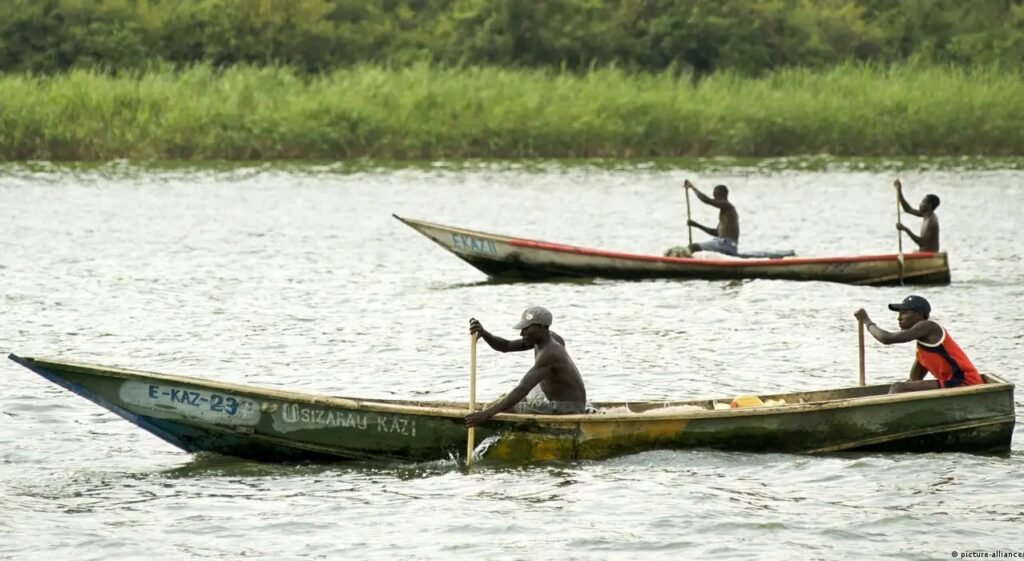
This was not a government operation from the start. It began with fishermen at night, confronting the dead, and making a human choice. One account from the time describes fishermen first seeing two dead bodies while fishing at night, Then a woman tied together with a baby, Then three more bodies of men with their pockets turned inside out. They went to their local council chairman and that is how the recovery effort began.
Alongside them was Thobani Mohamoud, who took on the responsibility of caring for the burial sites where many of the victims were finally laid to rest. For years, he ensured that those who had been discarded in death were given dignity in burial.
Mwicira-Mitali, whose documentary By the Shortcut – Iy’Ubusamo traces this entire journey from the Nyabarongo all the way to Uganda, puts it plainly: “They became part of our family history. Their sacrifice is the ultimate testament to humanity in the face of darkness.”
The scale: three memorial sites across Uganda
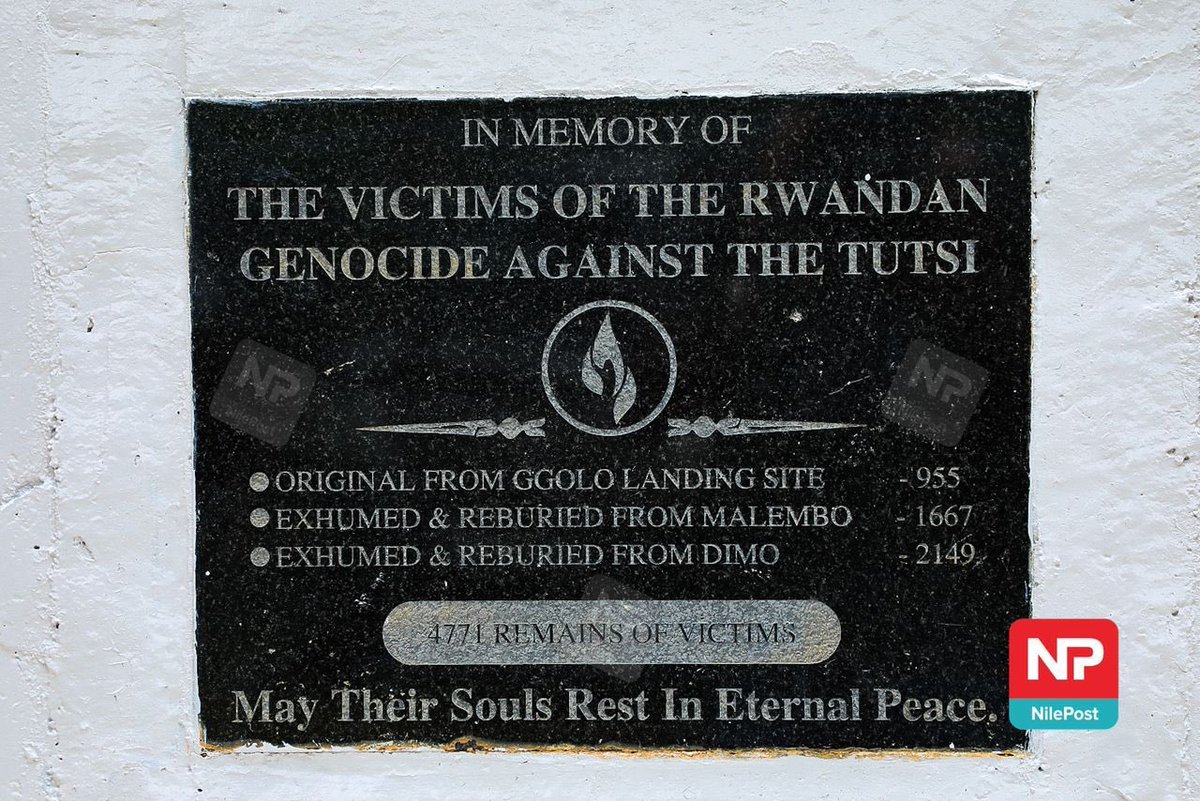
Ggolo remains one of the most significant genocide memorial sites outside Rwanda. It is the final resting place of 4,771 victims whose bodies were carried through the Nyabarongo and Akagera river systems into Lake Victoria and later recovered in Uganda. It is one of three genocide memorial sites in Uganda alongside Lambu in Masaka District and Kasensero in Rakai District, where a combined 10,983 victims are buried.
In Uganda alone, more than 17,000 bodies were recovered, according to IBUKA, the umbrella organization for associations of survivors of the 1994 genocide against the Tutsi in Rwanda.
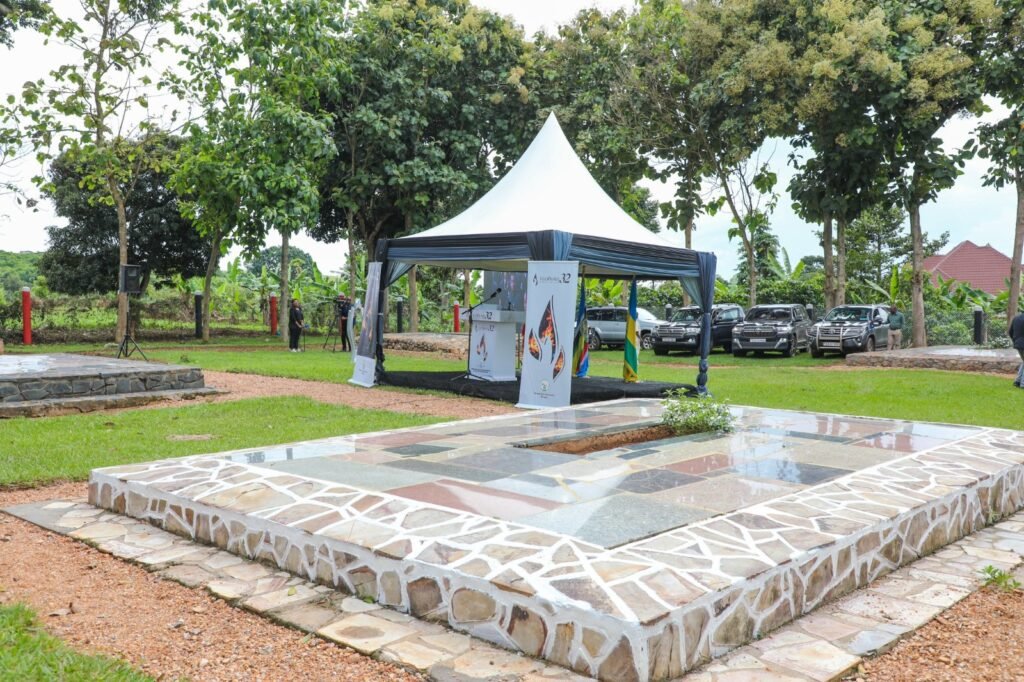
Rwanda later purchased land near Lake Victoria to establish proper memorials. The Rwandan government financed burials at these three sites.
Over the years, Ggolo has evolved into a center for remembrance and education. Future development plans include a memorial museum designed to preserve the victims’ history and strengthen genocide awareness for future generations.
Kwibuka 32: Uganda and Rwanda stood together, again
This story resurfaced during the final days of Kwibuka 32, Rwanda’s 32nd commemoration of the genocide, held under the theme Remember, Unite, Renew.
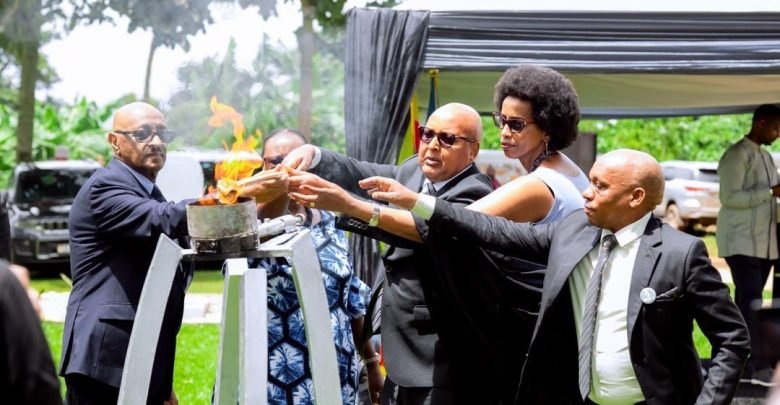
Uganda’s main Kwibuka 32 commemoration at Ggolo drew together officials, friends of Rwanda and community members in a solemn tribute. Uganda’s Minister of State Alice Kaboyo reaffirmed the close historical, cultural and geographical ties between Uganda and Rwanda, saying the relationship between the two countries remains rooted in friendship, cooperation and a shared vision for peace.
Rwanda’s own national closing ceremony took place at the Rebero Genocide Memorial, a site that honors politicians who were killed for opposing genocide ideology, attended by Prime Minister Dr. Justin Nsengiyumva, government officials, members of the armed forces, and the diplomatic corps.
The proximity of both commemorations, one in Kigali, one on the shores of Lake Victoria captures something important: Rwanda’s memory of the genocide does not end at its border. Some of it is buried in Uganda, tended by Ugandan hands.
Why it matters for Africa
The story of the 19 fishermen is, at its core, a story about African solidarity without a press release or a treaty behind it. No summit was called, No diplomatic cable was sent, Ordinary people, confronted with extraordinary horror, acted.
The government and the people of Uganda showed humanity, empathy and solidarity by getting out of the lake all those bodies and according them a decent burial. That act has since become a model for what regional memory-keeping can look like a shared grief across a border, honored by both nations every year during Kwibuka.
As the African Union, the Commonwealth, Morocco, South Korea, and the United States all held Kwibuka 32 ceremonies in April 2026, the annual commemoration provided an opportunity to honor the memory of over one million Tutsi killed, stand in solidarity with survivors, and reaffirm Africa’s collective commitment to preventing genocide, promoting unity, and safeguarding human rights.
The fishermen of Lake Victoria most of whom the world will never know by name are part of that story too.
In time, with support from the Rwandan government, some of these fishermen traveled to Rwanda to meet survivors, closing a painful but necessary circle between those who had lost loved ones and those who had helped recover them. That exchange has not ended. Every Kwibuka, Rwandans travel to Ggolo, and Ugandans stand with them.
The planned memorial museum at Ggolo will be the next chapter, a permanent institution outside Rwanda’s borders where the story of the rivers, the bodies, and the fishermen can be told to future generations. Mwicira-Mitali’s documentary By the Shortcut remains one of the only full accounts of this history on film. It deserves a wider screen.
“When we speak of those we lost, we must also speak of those who stood for them when the world could not,” Mwicira-Mitali says.
Thirty-two years later, that is still the ask.
About the Author