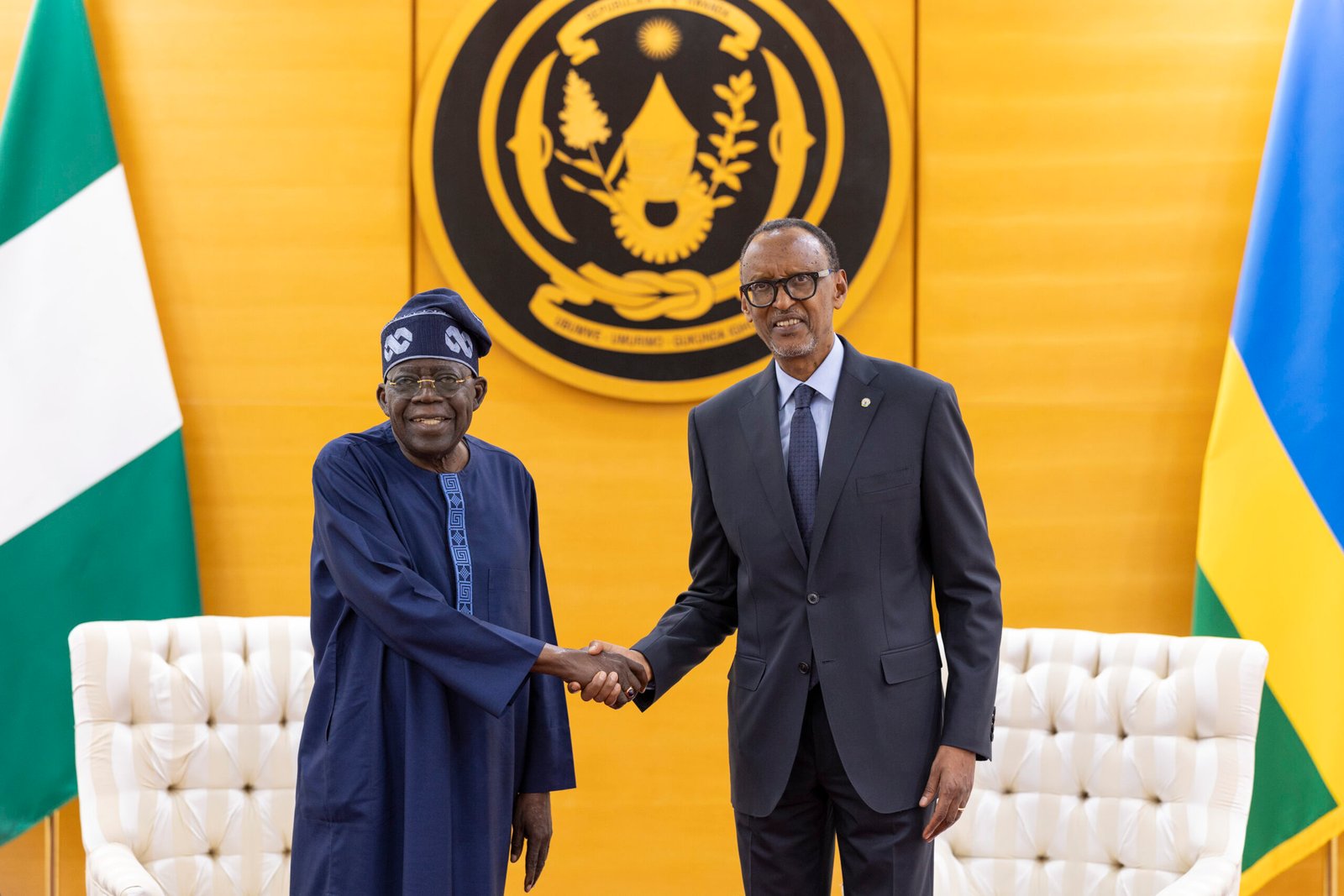
Nigeria formally opened its borders to Rwandan nationals on Friday, May 16, 2026, after the Nigeria Immigration Service confirmed the immediate implementation of a 30-day visa exemption, a policy set in motion just 48 hours earlier when President Bola Ahmed Tinubu of Nigeria and President Paul Kagame of Rwanda met face-to-face at the Urugwiro Presidential Village in Kigali.
The announcement came one day after President Tinubu made the declaration at the Africa CEO Forum in Kigali, Rwanda’s capital, where he framed the move as a direct reciprocation of Rwanda’s existing policy granting Nigerian citizens visa-free entry for up to 30 days. The Nigeria Immigration Service, in a press statement signed by its Service Public Relations Officer, Deputy Comptroller of Immigration Akinsola Akinlabi, confirmed that all international entry points, airports, land borders, and seaports had been directed to commence enforcement immediately.
The bilateral meeting on May 13 that sparked the policy shift covered far more than travel. According to statements from both the Nigerian State House and President Kagame’s office, the two leaders agreed to revive the Joint Permanent Ministerial Commission, a formal diplomatic mechanism originally signed between both countries in 2021 and dormant since, with Nigeria designated to host its next session. They also committed to activating pending Memoranda of Understanding in tourism, anti-illicit drugs, and anti-corruption cooperation, and exchanged positions on accelerating trade under the African Continental Free Trade Area agreement, which both governments have publicly championed.
On the economic side, Nigeria and Rwanda are in early discussions with RwandAir, the Rwandan national carrier over a flat-rate cargo arrangement designed to give Nigerian businesses more predictable shipping costs across the continent. The initiative builds on a model Nigeria piloted last year with Uganda Airways. For Rwanda, which has invested heavily in positioning Kigali as a continental logistics and conference hub, a direct cargo relationship with Nigeria, Africa’s largest economy by gross domestic product, would represent a significant commercial development.
The visa exemption itself is structurally straightforward. Rwandan nationals may enter Nigeria without prior visa arrangements for stays of up to 30 days, covering tourism, business travel, and official engagements. Those wishing to remain beyond that window must apply for the appropriate visa through a Nigerian embassy or high commission, or via Nigeria’s electronic visa platform. The Nigeria Immigration Service described the arrangement as a reflection of the two countries’ diplomatic ties and an expression of broader African integration principles.
President Tinubu’s visit to Kigali was the final stop of a three-nation diplomatic tour that also included France and Kenya, where he attended the Africa Forward Summit co-hosted by Kenyan President William Ruto and French President Emmanuel Macron. In his own statement, President Tinubu said Africa’s progress would not be built on declarations alone, but on trade flows, investment decisions, and the willingness of African governments to trust each other’s markets. The Africa CEO Forum, one of the continent’s most prominent annual gatherings of chief executives and heads of state, provided the platform for that message to be delivered directly to the audience that would act on it.
For Rwanda, the formalisation of the reciprocal arrangement closes a gap that had existed since Kigali extended its own visa-free offer to Nigerians. With the Nigeria Immigration Service’s confirmation now on record and enforcement active at all entry points, the policy is no longer a diplomatic intention, it is operative. What follows will depend on how quickly both governments move to seat the Joint Permanent Ministerial Commission and whether the RwandAir cargo discussions produce a workable commercial agreement before the end of the year.
About the Author