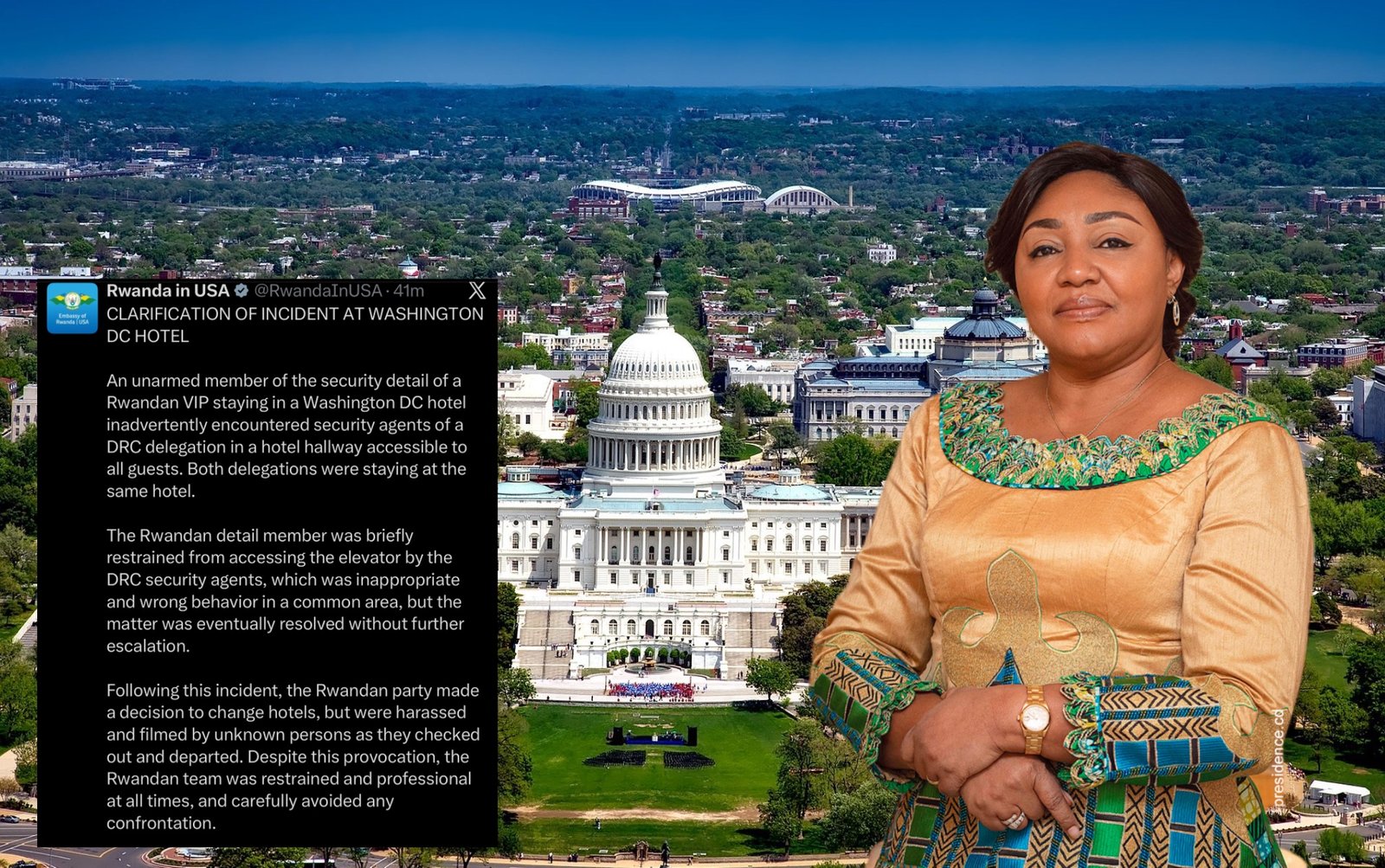
Rwanda’s Embassy in Washington has flatly rejected claims by the DRC government that Rwandan agents attempted to assassinate Congolese First Lady Denise Nyakeru Tshisekedi at a Washington hotel, calling the allegations a deliberate misrepresentation of a minor security encounter between two delegations staying at the same venue.
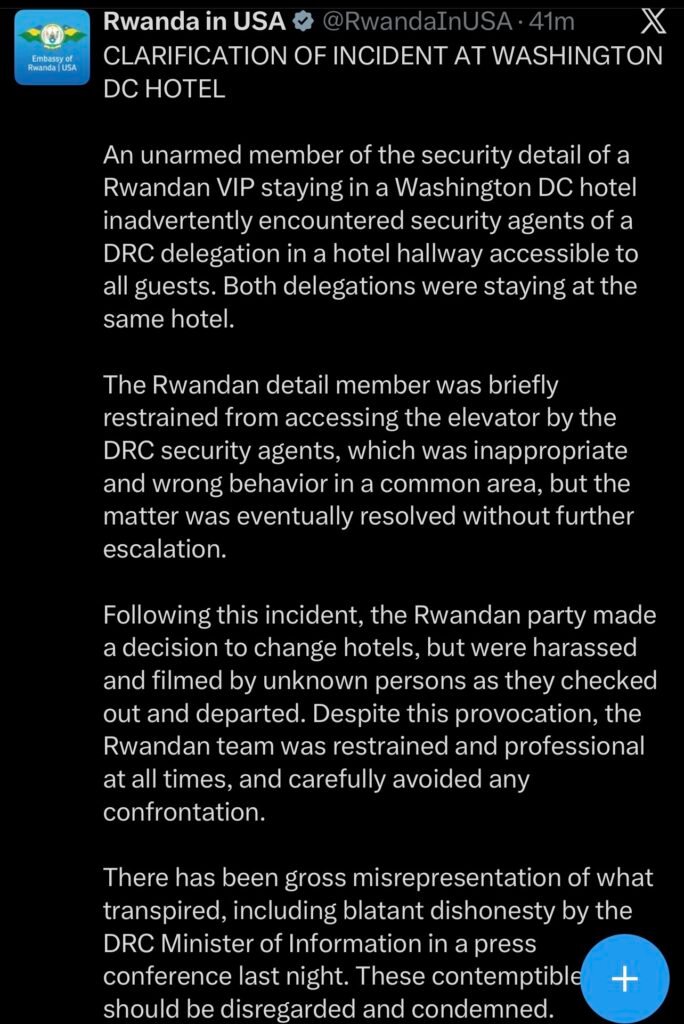
The embassy’s statement, posted on its official X account as @RwandaInUSA, said an unarmed member of a Rwandan VIP security detail was briefly blocked from accessing an elevator by DRC security agents in a common hotel corridor a hallway open to all guests.
It described the behaviour of the DRC agents as “inappropriate and wrong,” but said the matter was resolved without further escalation. The Rwandan party then chose to change hotels, and was harassed and filmed by unknown individuals as they checked out. The embassy said its team remained “restrained and professional at all times.”
DRC government spokesperson Patrick Muyaya had earlier told a press briefing that unidentified individuals had attempted to enter the hotel where the First Lady was staying, and drew a pointed correlation with Rwanda stopping well short of a formal accusation.
But pro-Kinshasa accounts on social media went significantly further, with one verified account claiming Rwandan intelligence agents had pre-booked rooms at the hotel days in advance, attempted to break into the First Lady’s suite, clashed with her guards, and fled in vehicles dispatched by the Rwandan embassy.
Rwanda’s embassy called those claims “blatant dishonesty” and said such misrepresentations should be “disregarded and condemned.”
The timing is diplomatically charged. The incident occurred days after DRC and Rwandan representatives met on March 17-18 in Washington under US mediation to advance the Washington Accords a peace framework the two countries signed in December 2025.
The new round of talks came just days after the United States sanctioned Rwanda’s military and imposed visa restrictions on several Rwandan senior officials, adding pressure to an already strained relationship. Washington has been recalibrating its posture in the region, shifting from a largely diplomatic approach to one more explicitly tied to strategic mineral interests a shift that has complicated Rwanda’s traditionally close ties with the US.
With peace talks still fragile and both sides operating in the same diplomatic spaces in Washington, the hotel standoff, however minor in reality is unlikely to pass quietly. Kinshasa will almost certainly use it to reinforce its narrative that Rwanda poses a direct threat, while Kigali will point to the episode as evidence of bad faith and deliberate provocation.
The next test is whether the Washington Accords process survives the propaganda war being fought alongside it.
About the Author