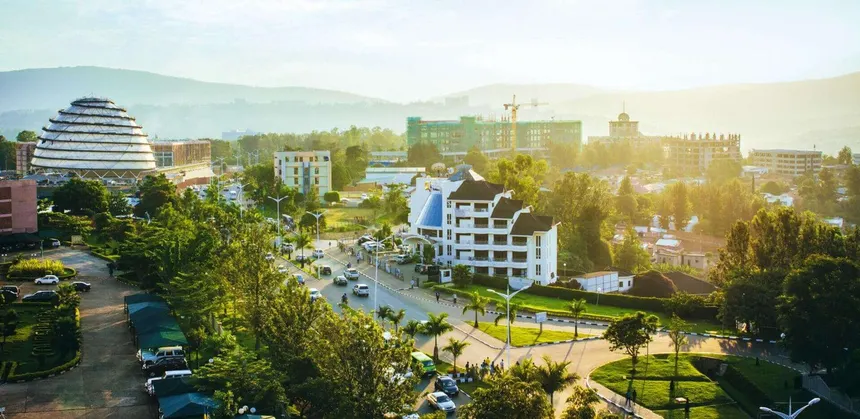
The Rwanda Development Board has released its 2025 Annual Report, confirming the country ended the year with investment, export, tourism, and mining figures that collectively place it among Africa’s most consistent economic performers.
The numbers published this week show a nation moving faster than its own targets.
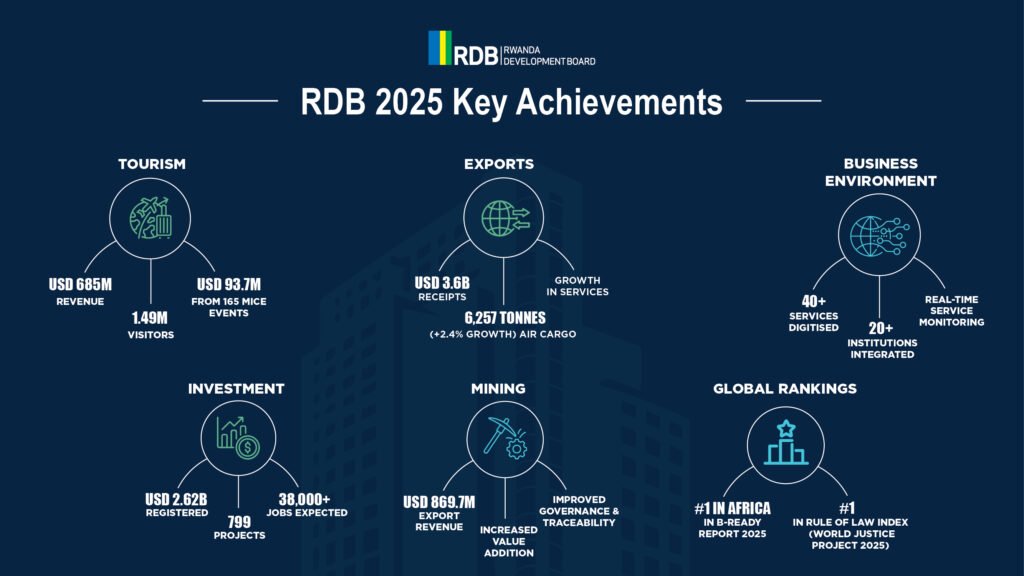
Rwanda registered USD 2.62 billion in investments across 799 projects, with over 38,000 jobs expected from those commitments. Export receipts reached USD 3.6 billion, supported by services growth and a 2.4% increase in air cargo volume to 6,257 tonnes.
The tourism sector brought in USD 685 million in revenue from 1.49 million visitors, with MICE events alone generating USD 93.7 million across 165 conferences and exhibitions.
The mining sector posted USD 869.7 million in export revenue, alongside improvements in governance and traceability that analysts say will matter more in the medium term than the headline figure. On governance, Rwanda held its position as the number one country in Africa in the World Bank B-Ready Report 2025 and ranked first globally in the World Justice Project Rule of Law Index 2025.
Why This Year Looks Different From the Last
The 2024 Annual Report had already set an aggressive pace. Rwanda pulled in USD 3.2 billion in investment commitments that year, a 32.4% increase on the prior year, while tourism brought in USD 647 million.
The 2025 figures tell a story of consolidation rather than acceleration: investment registered is lower at USD 2.62 billion, but project count and job expectations suggest the pipeline has shifted toward depth over volume. Tourism crossed the USD 685 million mark, beating the USD 700 million target the board had set at the start of the year. That target was not missed it was essentially met.
The context matters: Rwanda’s full-year economic growth for 2025 came in at around 9.4%, positioning it among the fastest-growing economies in sub-Saharan Africa, with construction, manufacturing, trade, and mining all contributing to a broad-based expansion.
The RDB figures sit inside that macro picture, they are the private sector and investment-facing layer of what is structurally a government-led growth story.
What Rwanda Is Building Toward
The 2025 report is not just a ledger of wins, it is also a governance document. The digitisation of over 40 government services, the integration of more than 20 institutions into a real-time monitoring framework, and the continued push into air cargo and Special Economic Zones point toward a deliberate infrastructure for scale.
Rwanda is not simply trying to attract more investors; it is trying to reduce the friction cost of doing business in ways that compound over time.
The B-Ready ranking reflects Rwanda’s commitment to creating a conducive environment for private sector growth, with reforms described as the foundation of its socioeconomic transformation. The Rule of Law ranking adds a layer that matters for high-value investors in finance, tech, and services sectors where contract enforceability and regulatory predictability are non-negotiable.
RDB CEO Jean-Guy Afrika, who assumed the role in January 2025 succeeding Francis Gatare, now leads the institution into its 2025–2030 strategic cycle, which carries targets that exceed everything the 2025 report achieved.
The strategic priorities going forward include expanding Special Economic Zones, deepening service delivery through digitisation, and strengthening ecosystems for innovation, conservation, and entrepreneurship.
The mining sector’s value-addition push is arguably the most consequential: Rwanda’s coltan, cassiterite, and wolframite exports have historically left the country before any processing. Changed governance frameworks and improved traceability flagged in this report are preconditions for capturing more of that value chain domestically.
Tourism will be watched closely. The visit Rwanda brand has lost its Arsenal FC sponsorship effective June 2026, after the clubs agreed not to renew. That deal generated global visibility that is hard to quantify but clearly contributed to MICE growth and high-value leisure arrivals. How the RDB retools its international brand strategy from mid-2026 onward will be a defining test of institutional agility.
The 2025 report also shows a country that has fully absorbed the UCI Road World Championships hosted on African soil for the first time, and the 20th edition of the Kwita Izina gorilla naming ceremony, both of which generated measurable tourism and media value.
About the Author