
A civil and highway engineer with more than 14 years of hands-on experience delivering infrastructure projects across Rwanda has formally entered the race for the Vice Presidency of the Institute of Engineering Rwanda, the country’s statutory body responsible for regulating and advancing the engineering profession, with a detailed, performance-benchmarked manifesto for the 2026–2029 term.
Engineer René Bazitunga, a Corporate Member of the Institute of Engineering Rwanda registered under number A197/EC/IER/2013 and currently serving as a Board of Directors member at Horizon Construction Ltd, launched his candidacy with what he describes not as a campaign document but as an engineering blueprint, a seven-pillar framework accompanied by measurable key performance indicators, a public scoreboard, and a commitment to quarterly reporting to the membership.
His bid arrives at a moment when Rwanda’s infrastructure ambitions are accelerating rapidly. The government’s National Strategy for Transformation places construction, road development, and urban infrastructure at the centre of the country’s push toward upper-middle-income status by 2035, creating both enormous opportunity and mounting pressure on the engineering profession to deliver at a higher standard than ever before. Against that backdrop, Eng. Bazitunga is making the case that the Institute of Engineering Rwanda requires leadership that can close the gap between institutional aspiration and on-the-ground reality.
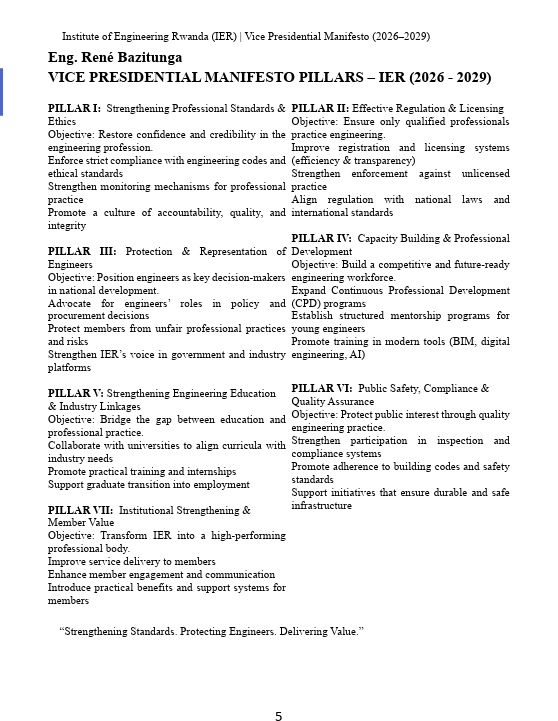
The manifesto is structured around seven pillars: strengthening professional standards and ethics; improving the efficiency and transparency of licensing and regulation; protecting engineers’ rights and ensuring their representation in policy processes; expanding capacity building and continuous professional development; deepening linkages between engineering education and industry; reinforcing public safety and compliance oversight; and transforming IER itself into a higher-performing, member-focused institution.
Each pillar carries specific numerical targets among them, reducing engineer registration processing time to under 15 days, facilitating more than 200 internship placements, training more than 300 engineers through Continuous Professional Development programmes annually, and achieving an 80 percent case resolution rate for complaints filed by members within 30 days.
What distinguishes the submission from typical professional association campaign materials is its insistence on accountability as a structural feature rather than a rhetorical gesture. Eng. Bazitunga has committed to a publicly accessible digital performance dashboard offering real-time visibility of all KPIs, alongside quarterly progress reports shared with the full membership and an annual review of commitments against results. He states plainly that any major commitment not delivered will be explained transparently, with corrective actions announced openly and that members retain the right to evaluate and question performance at any stage.
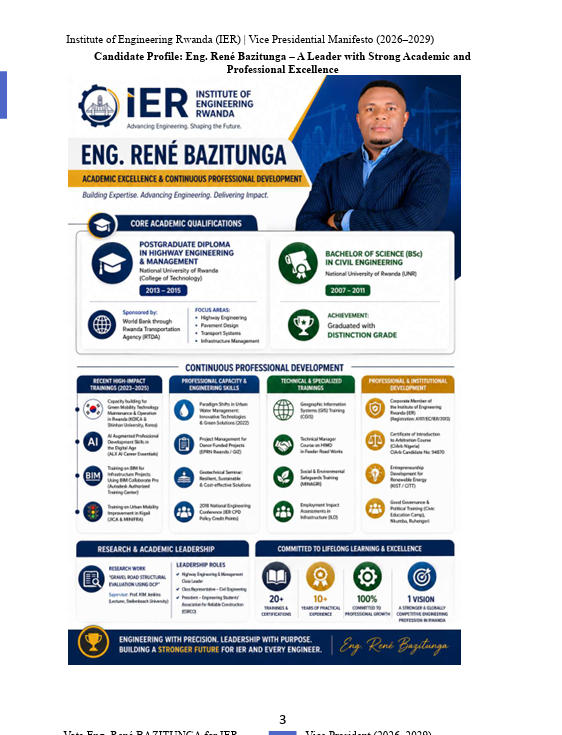
The candidate’s professional record spans the full spectrum of Rwanda’s construction sector. Holding a Bachelor of Science in Civil Engineering from the National University of Rwanda, where he graduated with distinction, and a Postgraduate Diploma in Highway Engineering and Management from the same institution’s College of Technology a programme sponsored by the World Bank through the Rwanda Transportation Agency.
Eng. Bazitunga has served as a Feeder Road Engineer under Rwanda’s Ministry of Agriculture, a Structural Engineer at Exalto Engineering and Supply Solutions Ltd, a Senior Construction Engineer jointly with Afriprecast Ltd and Millennial Construction Ltd, and a Senior Structural Engineer at Signon Corporation Ltd before moving into his current roles in senior project management and board governance.
His training profile is equally current: recent certifications include programmes in Building Information Modelling for infrastructure projects, AI-augmented professional development through ALX, green mobility technology maintenance with Korea’s Shinhan University, and urban mobility improvement in Kigali in partnership with the Japan International Cooperation Agency and Rwanda’s Ministry of Infrastructure.
The Institute of Engineering Rwanda serves engineers, technologists, technicians, and consulting firms operating across all engineering disciplines in the country. For international investors and development partners working on Rwandan infrastructure from the ongoing expansion of road networks to the construction of industrial parks and housing developments under the national urban development programme the governance and regulatory standards maintained by the institute directly affect the reliability, safety, and competitiveness of the construction sector they depend upon.
Elections for the IER Vice Presidency covering the 2026–2029 term are expected to be decided by the institute’s membership. Eng. Bazitunga’s campaign can be reached directly at +250 788 871 592.


About the Author