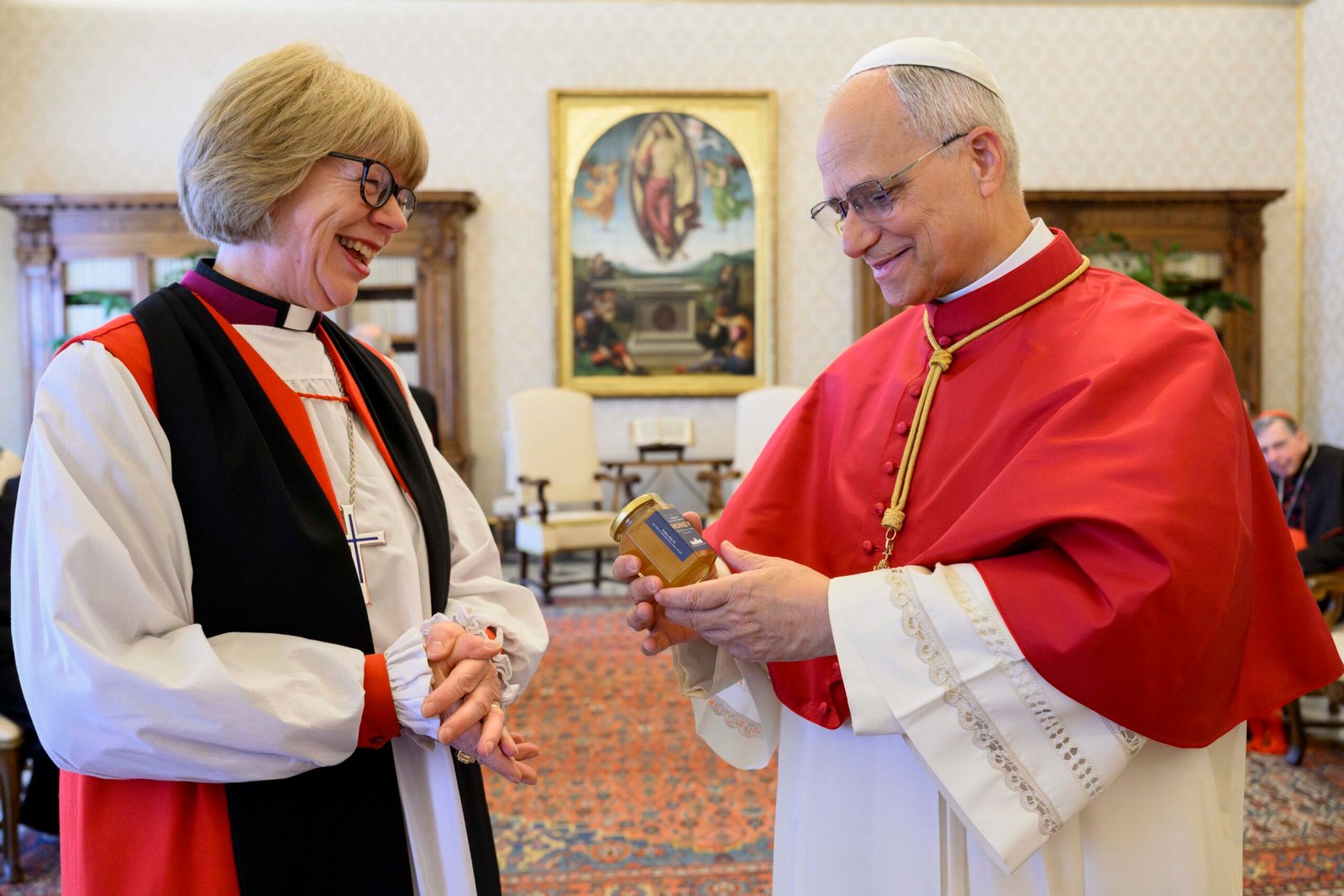
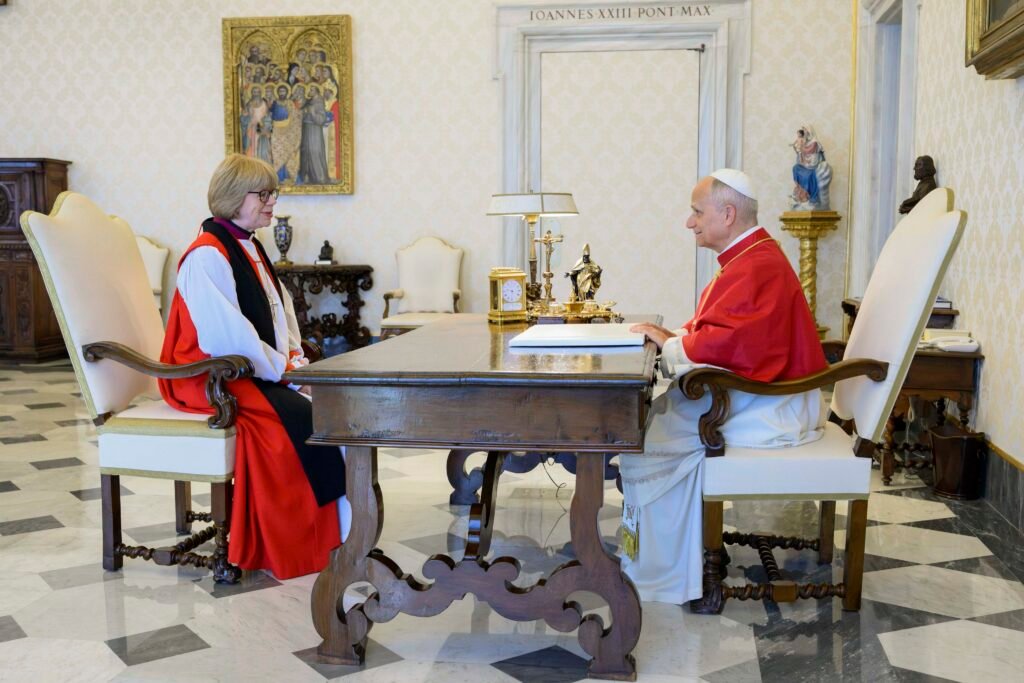
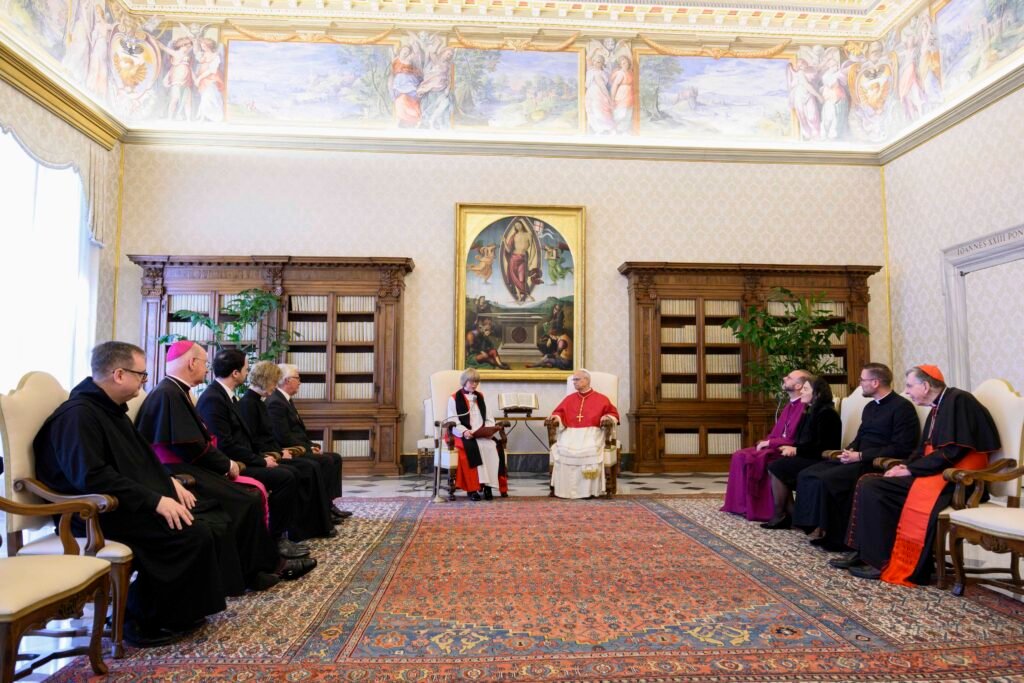
The leader of the world’s 1.4 billion Catholics and the newly installed head of the global Anglican Communion sat across from each other at the Vatican on Monday morning in a meeting that neither tradition could have imagined a generation ago.
Pope Leo XIV prayed with the Archbishop of Canterbury, Sarah Mullally, and committed to continuing work to overcome their churches’ differences “no matter how intractable they may appear”, a historic encounter with the first female leader of the Church of England and spiritual head of the Anglican Communion worldwide.
The encounter was layered with symbolism from the first moment. It was 60 years ago that the leaders of the Anglican and Roman Catholic Churches first came together since the Reformation of 1534, when Pope Paul VI and Archbishop Michael Ramsey signed a Common Declaration, the first formal ecumenical statement between the two churches at the Basilica of St. Paul Outside the Walls in Rome.
Mullally wore the episcopal ring that Paul VI gave Ramsey at that 1966 meeting, re-sized to fit her finger, carrying that history on her hand as she walked into the Apostolic Palace.
After their private meeting, the two leaders recited daytime prayer together in the Chapel of Urban VIII, with Leo acknowledging that “new problems” had arisen in recent decades, making the path toward full communion more difficult to chart.
The difficulties are real and documented. On the very day of the meeting, Pope Leo XIV reaffirmed the Catholic Church’s teaching that priestly ordination is reserved to men, a position that sits in direct tension with Mullally’s own existence as a female archbishop.
The Anglican Communion is itself divided on questions of women’s ordination and other doctrinal matters, with much of the Global South’s Anglican leadership holding conservative positions that have increasingly distanced themselves from Canterbury.
Yet both leaders chose to meet, to pray, and to speak publicly about the journey continuing. In her address, Mullally invited “a deeper practice of hospitality, not simply as welcome, but as a form of ministry,” describing herself as a shepherd who hopes to speak prophetically into the present reality and proclaim Christian hope as good news for the world.
For Rwanda and the broader African church, the stakes in this dialogue are not abstract. Rwanda’s Fifth Population and Housing Census puts the country at 40 percent Roman Catholic, with another 15 percent Protestant including Anglicans, and the Anglican Church of Rwanda counts over one million members across its 13 dioceses, making it one of the largest Christian denominations in the country.
That means the health of the relationship between Rome and Canterbury reverberates directly through Rwandan congregations, seminaries, and interfaith councils.
Africa also carries growing weight inside both global churches. Catholics on the continent now make up around 20 percent of believers worldwide, and Leo’s just-concluded 11-day Africa tour covering Algeria, Cameroon, Angola, and Equatorial Guinea signalled that the continent is central to how he sees the Church’s future, not its periphery.
There was a personal Africa thread running through Monday’s meeting itself. During her address to the Pope, Mullally told him that she would soon be following in his footsteps with a visit to Cameroon and Ghana in July, saying of his Africa pilgrimage: “It reminded us that despite our sufferings, people long for life in all its fullness.”
That planned Anglican visit to West Africa, coming months after a Catholic papal tour of the continent, sketches the outline of a quiet parallel engagement two global church leaderships returning to Africa, separately but in roughly the same moment.
The Catholic Church’s formal position on women’s ordination has not shifted. The Anglican Communion’s internal fractures over the same question have not healed.
But Leo and Mullally have now met, prayed, and spoken in the same room, in the same season at a moment when their shared voice on questions of peace, justice, and global inequality carries more weight than either institution commands alone.
For a continent that has lived through what religion can do when it fragments, and what it can build when it unites, the direction of this dialogue is not a distant theological question. In Rwanda, it is a lived one.
About the Author