
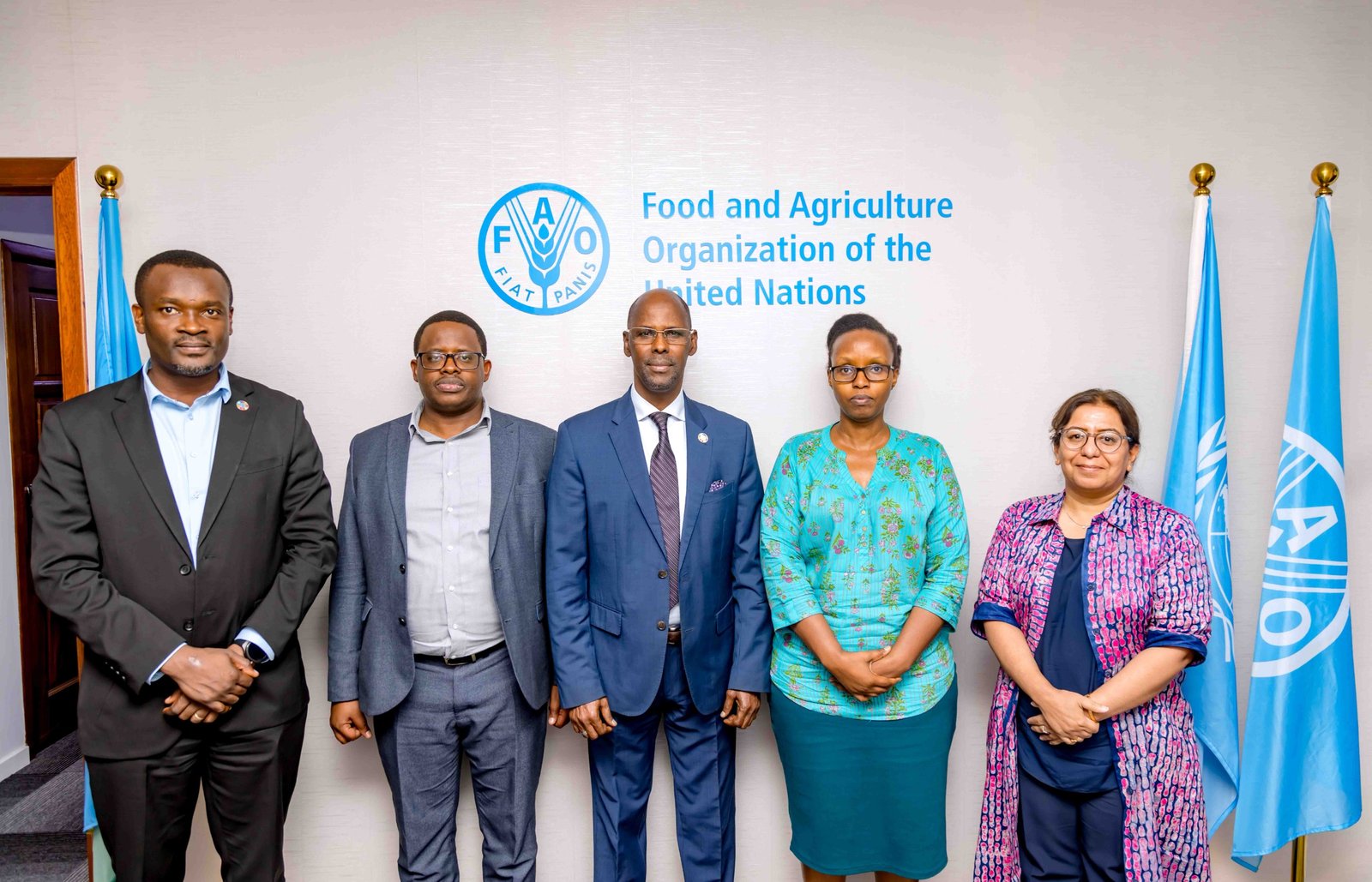
Rwanda’s agriculture ministry and the United Nations Food and Agriculture Organization (FAO) have held a strategic meeting to align high-impact projects with the country’s core national development blueprints, signalling a push to translate policy ambition into field-level results.
The meeting, confirmed by FAO Rwanda’s official channels, brought together the Permanent Secretary of the Ministry of Agriculture and Animal Resources (MINAGRI), Dr. Olivier Kamana, and the Director General of Planning from MINAGRI, alongside the FAO Rwanda country team.
The agenda centered on strengthening collaboration and identifying projects that can deliver measurable gains under the National Strategy for Transformation (NST2) and the Fifth Strategic Plan for Agriculture Transformation (PSTA5).
PSTA5, described as Rwanda’s first food systems and climate-resilient strategy, covers the period 2024 to 2029 and was designed to transform and modernize the agricultural sector in line with NST2 and Rwanda’s Vision 2050. But strategy documents alone do not move harvests.
What the meeting signals is that Rwanda is now in the harder implementation phase matching international partner resources to the specific gaps the plan has identified.
PSTA5’s five-year implementation requires a total budget of approximately RWF 6,622.6 billion (USD 5.1 billion), a figure that makes external alignment with partners like FAO not optional but essential.
This meeting follows a broader pattern of Kigali accelerating its agricultural partnerships. Rwanda’s Minister of State for Agriculture, Dr. Solange Uwituze, met with the FAO Director-General on April 15, 2026, just days before this planning-level engagement, suggesting a coordinated diplomatic push from MINAGRI at both political and technical levels simultaneously.
What’s at stake
Rwanda’s agricultural sector is not performing at the pace the targets demand. Data from the Rwanda Agriculture Board shows that average maize production reached 2 tonnes per hectare in 2024, still below the NST2 and PSTA5 target of 2.7 tonnes per hectare.
For Irish potatoes, the plan targets an increase from 8.5 tonnes per hectare in 2024 to 14.7 tonnes, a 79 percent jump. Those are not incremental improvements. They require coordinated, well-resourced interventions, exactly the kind FAO is positioned to help deliver.
Rwanda has established structured inter-ministerial dialogues, but formal mechanisms for sustained collaboration during PSTA5 execution remain limited, according to policy advisors close to the process.
The FAO engagement appears designed in part to fill that coordination gap at the international partnership level.
Rwanda’s NST2 also targets an increase in private investment from 15.9 percent of GDP to 21.5 percent and agrifood transformation is central to that economic ambition. FAO’s involvement, particularly in mobilizing aligned financing, feeds directly into this.
The conversation between MINAGRI and FAO will almost certainly move toward concrete project identification and resource commitments. Rwanda has already shown it can convert strategic dialogue into signed agreements quickly.
In March 2026, Rwanda signed a strategic Memorandum of Understanding to advance agricultural transformation, demonstrating the government’s appetite to formalize partnerships rather than let them stall at the meeting stage.
The focus on “high-impact projects” from the FAO side suggests the two parties are looking beyond technical assistance into areas where FAO financing instruments, knowledge networks, and country frameworks can directly back PSTA5 priorities, food systems resilience, climate-smart agriculture, and market integration.
For Rwanda, the broader lesson being tested here is whether a country of 14 million people, with limited arable land and high climate vulnerability, can build an agrifood system capable of feeding itself and exporting at scale by 2029.
About the Author