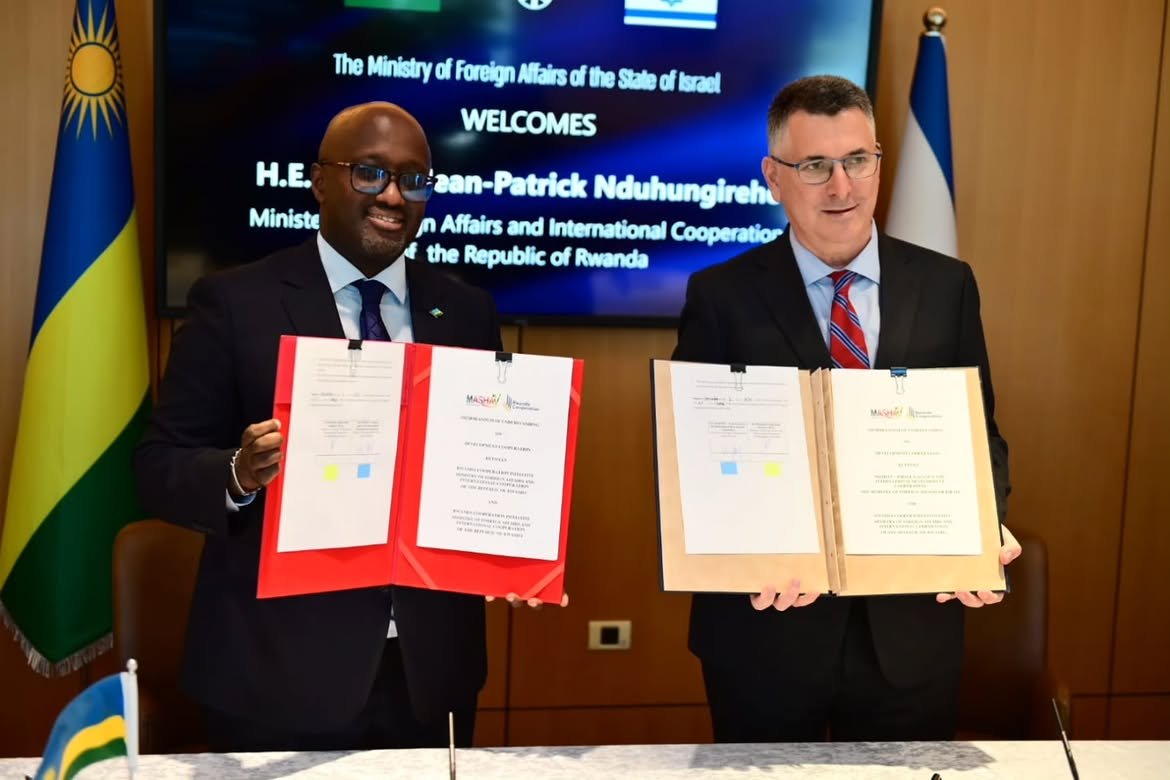
Rwanda and Israel have signed new cooperation agreements covering basic education, information and technology, higher education and scientific research, deepening a bilateral relationship both governments describe as rooted in shared historical experience.
A parallel agreement was signed between the Rwanda Cooperation Initiative, the Rwandan government body that coordinates international development partnerships, and Mashav, Israel’s Agency for International Development Cooperation, extending collaboration on development programs and capacity building.
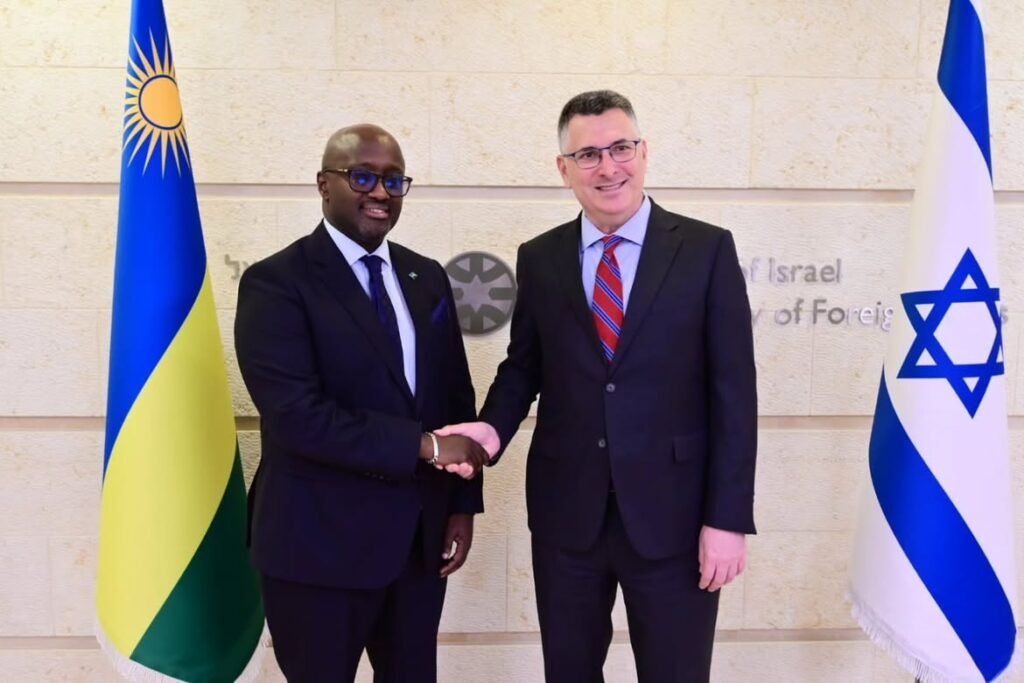
The agreements were signed in Jerusalem on July 6, 2026, by Rwanda’s Minister of Foreign Affairs and International Cooperation, Ambassador Olivier Nduhungirehe, and his Israeli counterpart, Foreign Minister Gideon Sa’ar.
The signing capped a visit during which Nduhungirehe and his accompanying delegation toured Jerusalem’s Old City, visited the Western Wall, and stopped at Yad Vashem, Israel’s national Holocaust memorial.Sa’ar told Nduhungirehe he was pleased to host him in Jerusalem, which he described as Israel’s eternal capital, framing the visit as evidence of the friendship built between the two countries.
He drew a direct line between the two nations’ histories, noting that both peoples have endured catastrophic violence, the Holocaust in the case of the Jewish people and the 1994 Genocide against the Tutsi in Rwanda’s case, and said neither country allowed that history to define its trajectory.
He pointed to the choice both nations made to rebuild rather than remain defined by tragedy as the foundation of what he called a special friendship, adding that he was glad the two countries were now exchanging knowledge in education specifically.
Sa’ar also argued that neither country’s small physical size reflects its actual standing, crediting the resilience and determination of both populations for outcomes that have made Rwanda one of Africa’s fastest-developing economies and Israel an international center for technology, science and investment despite decades of security challenges.
He said the agreements signed on July 6 demonstrate that the two governments’ cooperation is producing tangible results, describing a country’s people as its greatest asset.Nduhungirehe, for his part, said the Rwanda-Israel relationship extends beyond conventional diplomacy, characterizing it as bound together by shared histories of hardship, resilience, and a mutual determination to convert adversity into development.
He said the cooperation agreements signed by the two countries’ foreign affairs institutions will allow Rwanda and Israel to exchange approaches to challenges each has faced internally, while the education-specific agreements are intended to deepen knowledge exchange, training and capacity building between the two systems.
He described the day’s discussions as evidence of a shared commitment to expanding cooperation for the benefit of both countries and expressed confidence that the visit would further strengthen bilateral ties.The agreements follow a pattern of expanding technical cooperation between Kigali and Jerusalem that has centered heavily on education, agriculture and technology transfer in recent years, areas in which Israel has positioned itself as a development partner across the African continent.
For Rwanda, the deal adds Israel to a growing list of bilateral partners in higher education and scientific research as the government continues to position the country as a regional hub for innovation and applied research. Officials from both sides indicated the new agreements are expected to translate into expanded academic exchange programs, joint training initiatives and research collaboration in the coming months, with implementation to be coordinated through the Rwanda Cooperation Initiative and Mashav.
About the Author