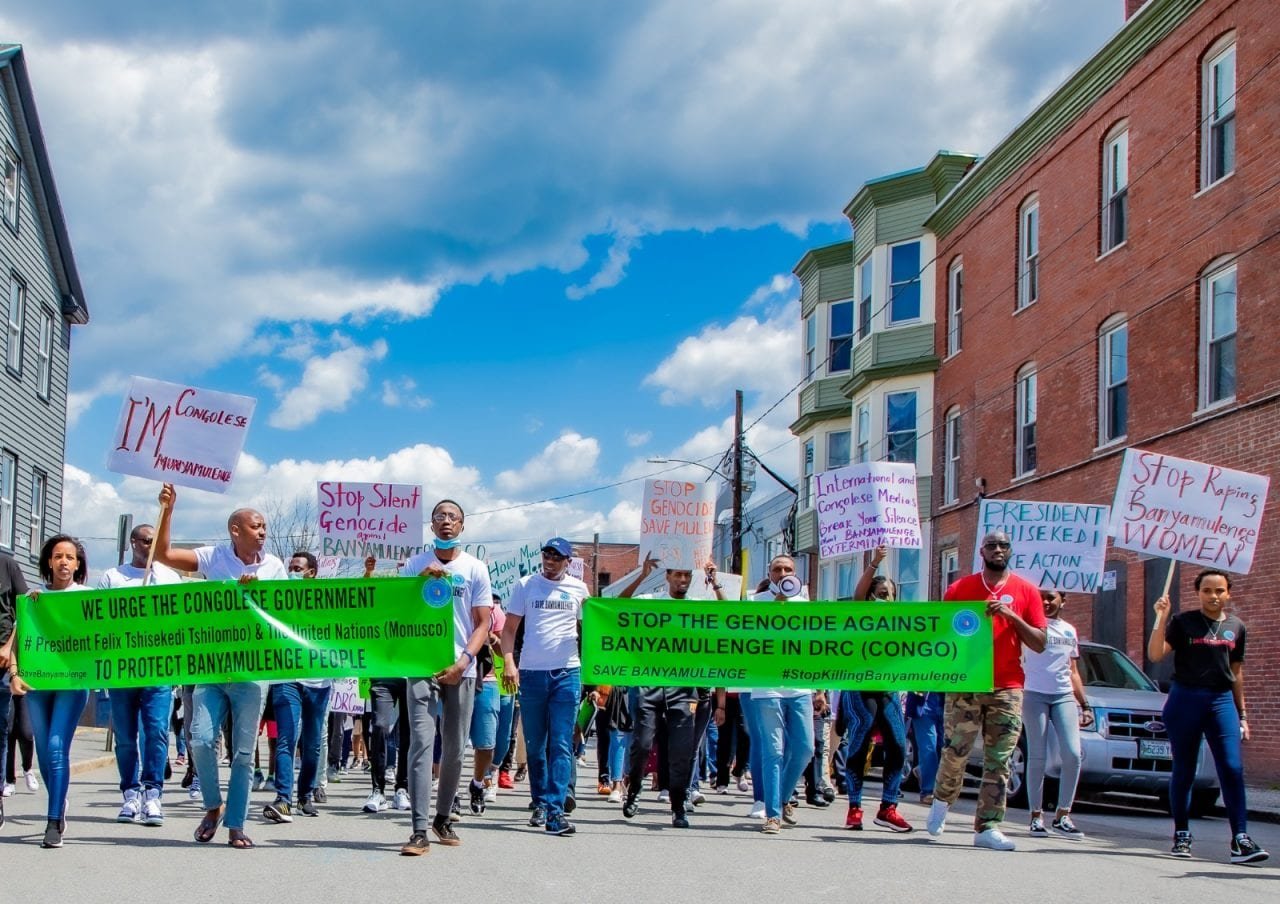
On Monday, April 20, thousands of Banyamulenge community members staged coordinated demonstrations in Washington D.C. and Nairobi, accusing Congolese government forces, Burundian troops, and allied FDLR militias of a sustained campaign of violence they describe as genocidal.
The protests, confirmed by AP photographers at the U.S. Capitol, marked one of the largest organized mobilizations by the community in years.
Since the M23 and Twirwaneho’s capture of Minembwe in March 2025, the area has been surrounded by Congolese and allied forces. Humanitarian organizations have had little to no access for over a year, and the lack of basic staples has driven prices to five times higher than elsewhere in South Kivu.
The blockade is not just logistical, it is lethal. Drone attacks in the highlands killed at least two Banyamulenge people in March 2026 alone: an 86-year-old man tending his cattle near Minembwe on March 23, and a 14-year-old boy killed in a field on March 30.
A medical worker inside Minembwe described the situation plainly: people are being bombed constantly and many are being injured.
The demonstrations were organized by the Mahoro Peace Association, a U.S.-based advocacy group, with a focus on communities in Minembwe, Mikenke, and Bijombo.
In Nairobi, marchers moved through the central business district before converging near a police station, chanting and carrying placards reading “Stop the Genocide,” pointing to reports of civilians dying from hunger due to restricted access to markets and aid.
In Washington, protesters gathered outside the U.S. Capitol, calling for international intervention specifically the lifting of blockades, an end to attacks on civilians, and the launch of independent investigations into alleged abuses. Protesters directly appealed to the Trump administration to step in and stop what they described as the extermination of their people in eastern DRC.
This is not new pressure, it is escalating pressure. As far back as October 2025, the global GAKONDO coalition sent an urgent letter to Massad Fares Boulos, the Trump administration’s Senior Advisor for Africa, accusing Burundian forces of joining the Congolese army in operations around Minembwe and calling for Washington to pressure both Kinshasa and Gitega into opening humanitarian corridors.
That letter was copied to UN Secretary-General António Guterres, the heads of state of Rwanda, Kenya, Tanzania, Uganda, and Zimbabwe, and the EU’s top foreign policy chief.
On the ground, the military situation is deteriorating fast. Since December 2025, the Congolese army, backed by Burundian units and Wazalendo militias, has been conducting multiple offensives in the Minembwe highlands without managing to dislodge the armed groups present.
Just days before the protests, a large Burundian military contingent was reported advancing toward Minembwe through the Bibokoboko area in Fizi territory, having crossed Lake Tanganyika from the port city of Rumonge.
Meanwhile, close to 98 percent of Banyamulenge families fled Uvira after warnings that they would be targeted because of their Tutsi appearance, with about 990 people now living in a provisional displacement site in Kamanyola without humanitarian assistance and no safe path to return.
The protests land at a diplomatically sensitive moment. The Congolese peace process still fragile after the Luanda and Qatar-mediated talks between Kinshasa and Kigali has not addressed the specific situation of the Banyamulenge, whose fate sits at the intersection of the DRC-Rwanda dispute, Burundian military involvement, and long-running ethnic tensions in South Kivu.
Advocates are calling on the U.S. Congress to press for humanitarian corridors, demand that Burundian forces cease aerial and drone strikes in civilian areas, and scale up assistance to displaced families.
Whether the Trump administration which has shown limited appetite for deep engagement in the Great Lakes responds substantively will determine whether these protests mark a turning point or simply another moment of visible grief with no political consequence.
About the Author