
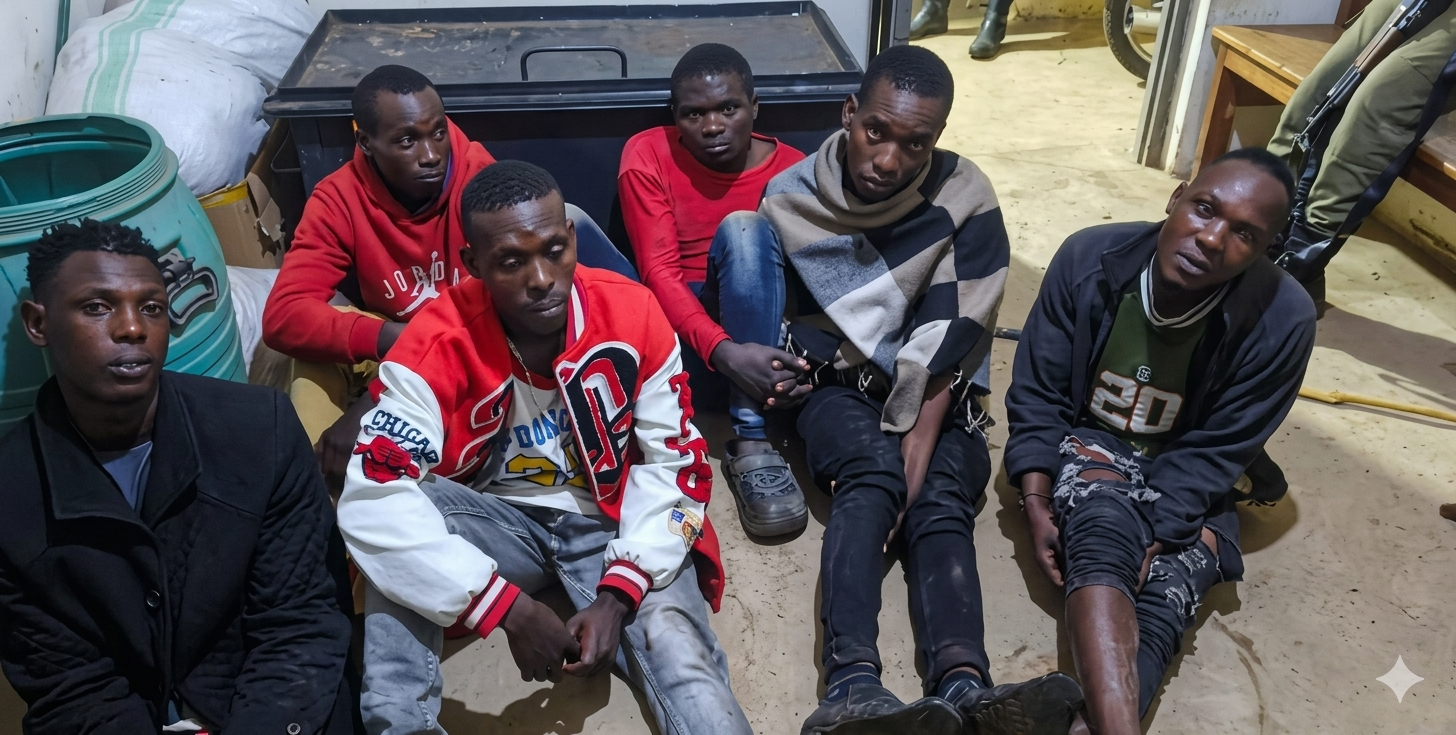
Twenty-five Rwandan nationals are in custody in Uganda after security forces raided an illegal mining operation at a government-owned wolfram site in the southwestern district of Kisoro, police announced on May 3, 2026. The suspects, alongside three Ugandan nationals, were arrested during an intelligence-led operation at the Kirwa Wolfram Mines in Kabaya Village, Busengo Parish, Nyarubuye Sub-county, a state-controlled site overseen by Uganda’s Ministry of Energy and Mineral Development.
All 28 individuals taken into custody were found in possession of approximately 30 kilograms of wolfram that had already been extracted from the site. Elly Maate, the police spokesperson for Uganda’s Kigezi Region, confirmed that the operation was triggered by intelligence gathered since the beginning of the year.
According to Maate, the 25 Rwandan suspects had entered Uganda through porous and unregulated border crossing points. All suspects have been formally charged with illegal mining as well as unlawful entry and stay in Uganda without valid documentation, and will be brought before a court once investigations are complete.
The arrests come at a particularly sensitive moment for Rwanda’s mining sector. Rwanda’s exports of tin, tungsten, and tantalum surged by 46.2 percent in 2025, a performance significant enough to narrow the country’s trade deficit from three billion US dollars in 2024 to 2.7 billion US dollars in 2025, according to official figures from the Ministry of Finance and Economic Planning. Wolfram, the ore form of tungsten, sits at the centre of that boom.
Rwanda holds Africa’s largest tungsten mine and consistently ranks among the continent’s top exporters of tin and tantalum by value. That strategic position has drawn heightened global attention, particularly as China controls approximately 80 percent of global tungsten production and in 2025 introduced restrictive export policies that limited authorised exporters to just 15 entities for the 2026–2027 cycle, creating immediate sourcing constraints for Western defence and industrial buyers.
The cross-border nature of Sunday’s arrests points to a longstanding enforcement challenge in the Kisoro area. The district shares a mountainous frontier with Rwanda’s Northern Province, and the proximity of mineral-rich terrain on both sides of the border has historically complicated the task of distinguishing legal from illegal extraction.
Under Uganda’s Mining and Mineral Act of 2022, illegal mining carries a penalty of up to six years in prison or fines of approximately one billion Ugandan shillings. Uganda’s Ministry of Energy and Mineral Development has in recent months intensified crackdowns across western districts, with operations targeting unlicensed extraction of tin, iron ore, gold, and wolfram in Kabale, Rubanda, Ntungamo, and Isingiro, in addition to Kisoro.
Neither the Government of Rwanda nor Rwanda’s Ministry of Mines, Petroleum and Gas Board had issued a public statement on the arrests as of the time of publication. The Rwandan nationals in custody face a court process in Uganda, the timeline for which depends on the completion of ongoing police inquiries. How Kigali responds diplomatically or otherwise to the detention of its nationals on charges tied to a mineral that has become central to Rwanda’s national economic strategy will be closely watched by investors and regional observers alike.
About the Author