
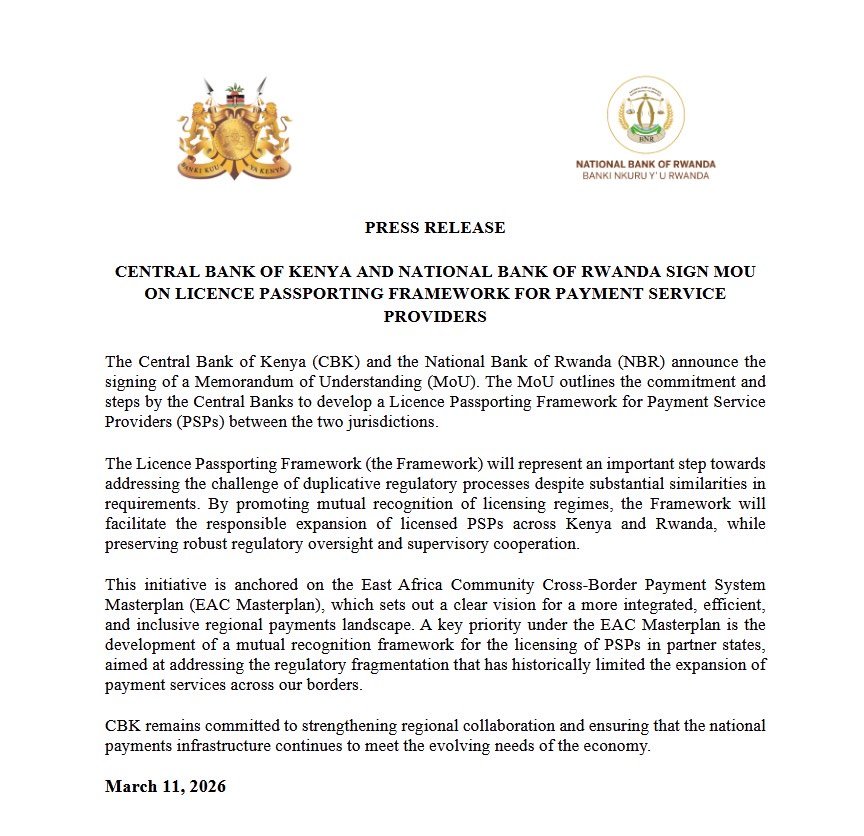
The National Bank of Rwanda and the Central Bank of Kenya and the have signed a Memorandum of Understanding (MoU) aimed at allowing licensed payment service providers to operate more easily across both countries.
In a press release issued on March 11, 2026, the two central banks announced the creation of a Licence Passporting Framework for Payment Service Providers, a mechanism that will allow companies licensed in one country to operate in the other through mutual recognition of regulatory approvals.
According to the statement, the framework is designed to reduce duplicative regulatory processes while maintaining strong oversight. This will enable licensed payment service providers to expand operations between Rwanda and Kenya without having to repeat the entire licensing process in each jurisdiction.
The initiative is part of broader regional efforts under the East African Community Cross-Border Payment System Masterplan, which seeks to build a more integrated, efficient and inclusive payments ecosystem across the region.
Officials say the framework will address long-standing regulatory fragmentation that has historically slowed the growth of cross-border payment services within East Africa.
The agreement also aligns with wider continental ambitions to strengthen financial integration through initiatives such as the African Continental Free Trade Area digital trade and payment frameworks and the Pan-African Payment and Settlement System both designed to reduce reliance on foreign payment infrastructure and make intra-African trade easier.
In recent years, Rwanda has increasingly pushed for deeper financial integration across the continent. Speaking earlier this week at the Inclusive FinTech Forum in Kigali, Prime Minister Justin Nsengiyumva emphasized that Africa must develop financial systems it controls if the continent is to achieve economic independence.
President Paul Kagame has also repeatedly called for stronger African financial infrastructure, arguing that fragmented payment systems remain one of the biggest obstacles to intra-African trade.
The new Rwanda–Kenya framework is expected to serve as a practical step toward that goal, allowing fintech companies and payment platforms to scale more easily across borders while supporting the region’s broader digital economy agenda.
About the Author