
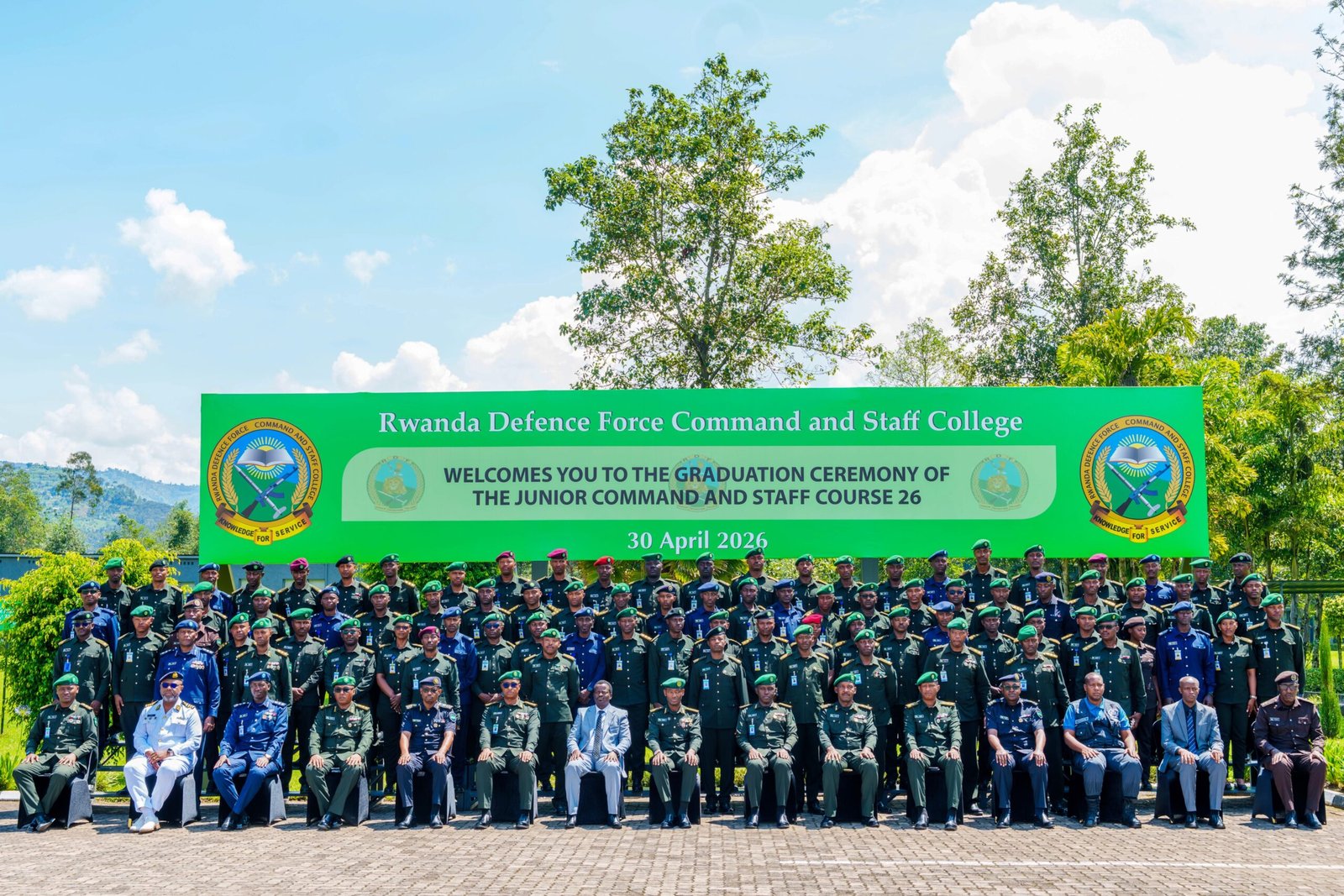
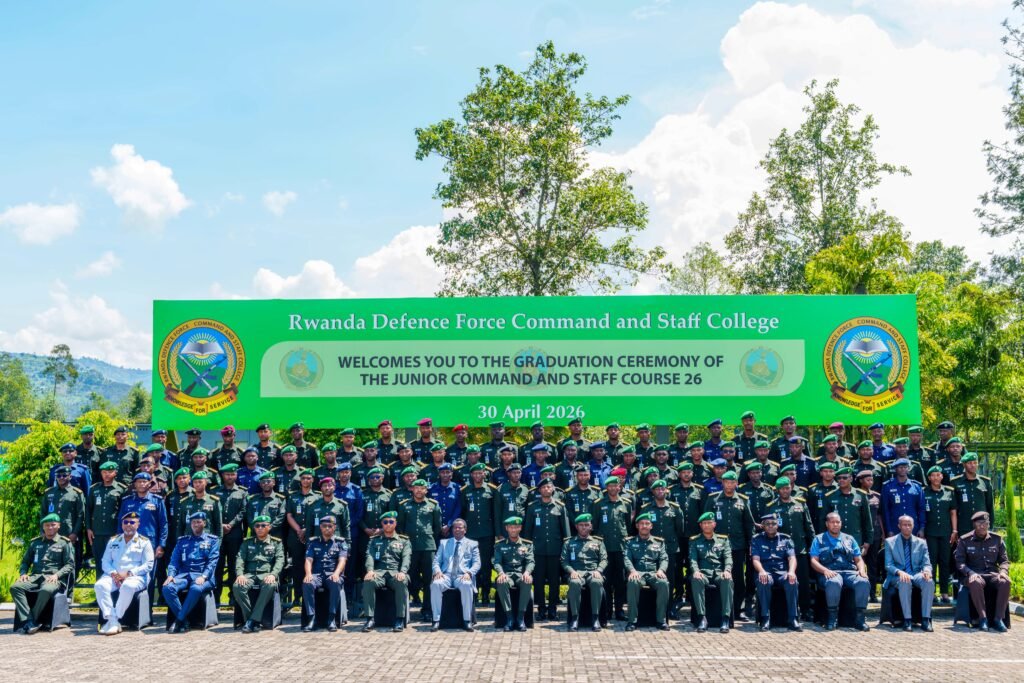
Seventy-four officers drawn from Rwanda’s three uniformed services have graduated from the Junior Command and Staff Course at the RDF Command and Staff College in Nyakinama, Musanze District, completing 22 weeks of intensive tactical and operational training that qualifies them to command at Brigade level.
Five of the graduates are women, a number the RDF chose to highlight in its announcement, reflecting the force’s continued push toward gender representation in professional military education.
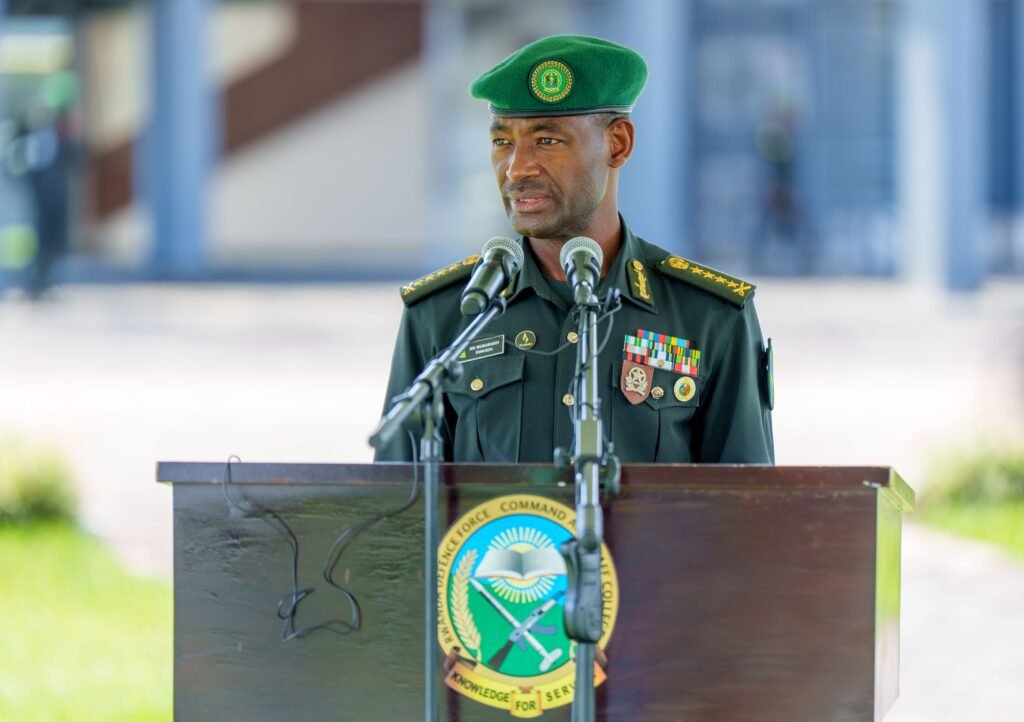
The graduation of Intake 26, presided over Thursady by RDF Chief of Defence Staff General MK Mubarakh, brought together officers from the Rwanda Defence Force, the Rwanda National Police, and the Rwanda Correctional Service, the same joint-service format the course has maintained across multiple intakes, underlining the institutional logic of building a common operational and leadership language across Rwanda’s security architecture.
The Junior Command and Staff Course is the RDF’s primary mid-career qualification for field-grade officers, typically Majors and Captains. Its mandate is precise: equip officers to exercise tactical command responsibilities up to Brigade level and to perform military staff functions effectively.
That means graduates leave Nyakinama able to plan and execute operations at a formation level, not just lead individual units. It is the difference between an officer who can command a company and one who can manage the staff architecture that makes a brigade function.
The course has historically run between 21 and 22 weeks, with the curriculum focused on military knowledge, operational planning and conduct, national security interests, and the changing character of regional and global security challenges.
The content has evolved over successive intakes, more recent versions have placed increasing emphasis on complex operating environments, with Army Chief of Staff Major General Vincent Nyakarundi telling a previous graduating class: “You need to understand the increasingly complex issues in our operating environment. I am confident that this course has equipped each of you with the necessary skills, knowledge and attitude.”
The inclusion of RNP and RCS officers alongside RDF personnel is not ceremonial. Rwanda’s security doctrine increasingly treats the three services as interdependent, particularly in areas like internal security, border management, and peacekeeping support roles where military, police, and correctional functions overlap.
Recent intakes have typically included officers from all three services, with the RDF contributing the majority and the RNP and RCS sending smaller contingents to build inter-agency professional links.
For RNP and RCS officers, completing the JCSC carries a specific value: it gives them a common command framework and professional vocabulary with their RDF counterparts, essential for joint operations and crisis response scenarios where the three services must coordinate under a unified command structure.
Five Women in the Graduating Class
The RDF’s decision to specifically name the five female officers in its graduation announcement is deliberate. Rwanda has long set regional benchmarks on gender in public life, from its parliament to its judiciary, and the military has been working to bring the same intentionality to senior leadership pipelines.
The JCSC is a gateway course: officers who graduate here are positioned for promotion and command appointments that will define Rwanda’s security leadership over the next decade.
Brigadier General Andrew Nyamvumba, Commandant of the RDF Command and Staff College, has consistently emphasised that discipline, teamwork, and dedication are the qualities the course is designed to produce qualities that apply equally regardless of gender.
Five out of 74 is not parity. But in a military context, where the pipeline narrows sharply at officer level, it represents a cohort that will carry the RDF’s gender inclusion agenda into the command ranks on mission, at home, and in the peacekeeping theatres where Rwanda’s reputation is built.
The 74 new graduates return to postings across the RDF’s divisions, the national police, and Rwanda’s correctional institutions. Some will eventually be considered for the Senior Command and Staff Course, the next rung in professional military education and for command appointments at formation level.
Others will enter staff roles at RDF Headquarters, where the planning and coordination skills developed at Nyakinama are applied daily.
For General Mubarakh, presiding over this graduation, the second in two days after Wednesday’s Military Police pass-out at Kanombe signals an RDF that is not standing still.
Two major graduation ceremonies in 24 hours from two different institutions is a statement about the pace at which Rwanda is professionalising its security forces, even as those same forces are deployed across four countries and managing one of the most demanding operational profiles in the continent.
About the Author