
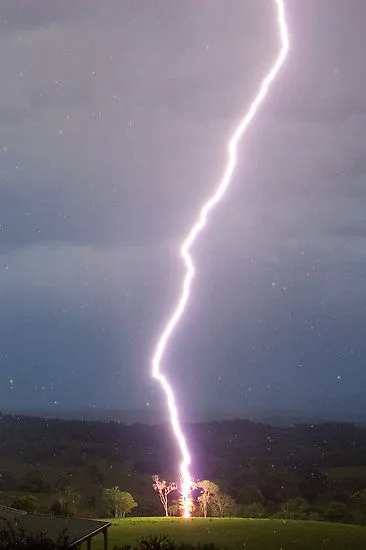
According to the Ministry in charge of Emergency Management in Rwanda, Seven people lost their lives to lightning strikes across three Rwandan districts on May 3, 2026, as the country’s peak rainy season delivered deadly storms to communities in the Northern and Western Provinces.
Two of the fatalities occurred in Burera District, a mountainous district in northern Rwanda that sits among the country’s most disaster-exposed zones. A 39-year-old man from Sarambwe Village in Gacundura Cell, Rwerere Sector, was struck inside his home at 2:30 in the afternoon, with his wife and four children present. The second victim, a 56-year-old man from Gatagarajite Village in Ruyange Cell, Cyeru Sector, was struck while returning home from collecting grass for his cattle.
Burera District Mayor Mukamana Soline confirmed the deaths to IGIHE.COM, expressing her condolences to the bereaved families. “It is true, two residents lost their lives due to lightning disasters,” she said. “We sympathize with the families who lost their loved ones.” Mayor Mukamana Soline added that awareness campaigns on lightning safety are ongoing in the district.
The remaining five deaths were spread across Rutsiro and Rubavu, two districts in the Western Province where lightning-related fatalities have historically been among the highest in the country. In Rubavu District, a 14-year-old girl from Ryabizige Cell in Cyanzarwe Sector was struck at her home at 2:00 in the afternoon, while a 38-year-old man from Gihonga Cell in Busasamana Sector also lost his life. In Rutsiro District, a 78-year-old woman from Nyakarera Cell in Ruhango Sector and a 32-year-old woman from Rurara Cell in Mushonyi Sector were both killed. The day’s final victim was an 80-year-old man struck at his home in Karambi Cell, Kivumu Sector, at 4:50 in the evening.
The deaths come against a documented pattern of lightning being Rwanda’s deadliest environmental hazard by immediate fatality count. According to Rwanda’s National Institute of Statistics, during the 2023-2024 period the country recorded 1,114 separate lightning incidents, with lightning alone accounting for roughly 45 percent of all disaster-related fatalities in that cycle. The Ministry in Charge of Emergency Management known by its Kinyarwanda acronym MINEMA, reported in March 2026 that between 2024 and 2025 alone, at least 167 people were killed by lightning and over 374 were injured nationwide.
Rwanda’s hilly topography is a central driver of this risk. According to Aimable Gahigi, Director General of the Rwanda Meteorology Agency, the mountainous terrain of the Western and Northern Provinces creates favorable conditions for the formation of cumulonimbus clouds, the thunderstorm clouds responsible for lightning which is why districts like Burera, Rubavu, and Rutsiro consistently record the highest strike rates in the country.
MINEMA has been expanding its response on two fronts: the physical installation of lightning protection systems on schools, churches, and public buildings, and community-level awareness campaigns targeting high-risk behaviors, including the use of mobile phones during storms, sheltering under trees, and remaining outdoors when thunderclouds form. Claude Twishime, Head of Communication at MINEMA, said earlier this year that while lightning remains among the country’s most lethal hazards, most deaths are preventable. “When citizens follow the recommended safety measures, the number of fatalities can significantly decrease,” he said.
With the March-to-May rainy season still active across the country, and Meteo Rwanda having forecast above-average rainfall in the very districts now recording fatalities, local authorities are expected to intensify outreach campaigns in the days ahead. The pace of deaths this season will test how effectively those campaigns are translating into behavioral change in rural communities where lightning risks remain high and protective infrastructure is still being scaled.
About the Author